The GTM Misconception That Costs Founders Six Months
Here is the most common GTM mistake I see: a founder builds a product for 9 months, gets it to a demoable state, and then calls a team meeting to ‘figure out the go-to-market.’
GTM is not something you figure out after the product is built. By the time you have a built product, dozens of consequential GTM decisions have already been made — often by accident. Your pricing is constrained by your cost structure. Your sales motion is constrained by your onboarding complexity. Your target segment is constrained by the compliance requirements you did or did not build in. Product decisions and GTM decisions are the same decisions, made in sequence. The founders who understand this build products that are commercially structured from day one.
What GTM Strategy Actually Contains
GTM strategy is frequently misunderstood as a synonym for marketing or sales. It is neither. GTM strategy is the totality of decisions about how your product creates, delivers, and captures value in the market. It contains five interconnected components:
Target Segment Definition: Not a demographic profile — a precise definition of the buyer who has the problem you solve, the budget to pay for your solution, and the authority to say yes. The more specific you are, the faster you move.
Positioning and Messaging: Why should this specific buyer choose you over all alternatives, including the alternative of doing nothing? Answer with specificity, not aspiration.
Pricing and Packaging: How you price is a signal about how you see your value. Pricing too low tells buyers you are uncertain about your worth. Pricing without clear structure tells buyers they are not sure what they are buying.
Sales and Distribution Motion: How does a buyer discover you, evaluate you, and buy from you? This motion must match the complexity and price point of your product.
Customer Success Architecture: How does a new customer get to value, and how quickly? Time-to-value is the most important post-sale metric in B2B — it determines whether your customer renews, expands, and refers.
| GTM is not the wrapper around your product. It is the commercial logic of your product — and it needs to be designed with the same rigour. |


Segment Before You Do Anything Else
The most leveraged GTM decision you will make is segment selection. Not because your product cannot serve multiple segments — it probably can — but because your initial GTM motion needs to be focused enough that you can create genuine density in one segment before expanding.
Segment selection is not about finding the biggest market. It is about finding the segment where you have the shortest path to a reference customer, the clearest product-market fit signal, and the most defensible position relative to alternatives.
For a B2B fintech product, that might mean starting with a specific company size, geography, and vertical. ‘All businesses that might need financing’ is a market. ‘Singapore manufacturing importers who need faster access to working capital between purchase orders and supplier payment deadlines’ is a customer. You can write compelling positioning for a customer. You cannot write compelling positioning for a market.
Pricing as a Strategic Signal
Most early-stage founders underprice. Not because they lack confidence in their product, but because they fear higher pricing will lose them deals. What they miss is that pricing is a quality signal in B2B. A buyer evaluating a $500/month solution and a $5,000/month solution for the same problem does not assume both are equally good. They assume the $500 solution has a catch.
Pricing strategy for B2B products should answer three questions: What value does my product create for the buyer, expressed in their currency? What is the buyer’s next-best alternative, and what does that cost? At what price point does the buyer feel the risk of choosing me is proportionate to the price? The answer to these three questions almost always yields a price higher than the founder’s initial instinct. Charge it. You can always negotiate down. You cannot negotiate up.
The Sales Motion Has to Match the Product
One of the most common GTM failures is a mismatch between product complexity and the sales motion designed to sell it.
Complex, high-value B2B products require a consultative sales motion. The buyer needs to trust you before they buy from you. They need to see that you understand their specific situation. This trust is built through discovery conversations, through the quality of your diagnostic, through the specificity of your proposal. A self-serve motion for this category produces low-quality leads and long cycles that collapse without human intervention.
Conversely, a high-touch enterprise sales motion for a product priced at $200/month per seat is financially unsustainable — the customer acquisition cost exceeds lifetime value before the first renewal. Match the motion to the price point. Build the product to support the motion.
GTM and Product Roadmap Are the Same Roadmap
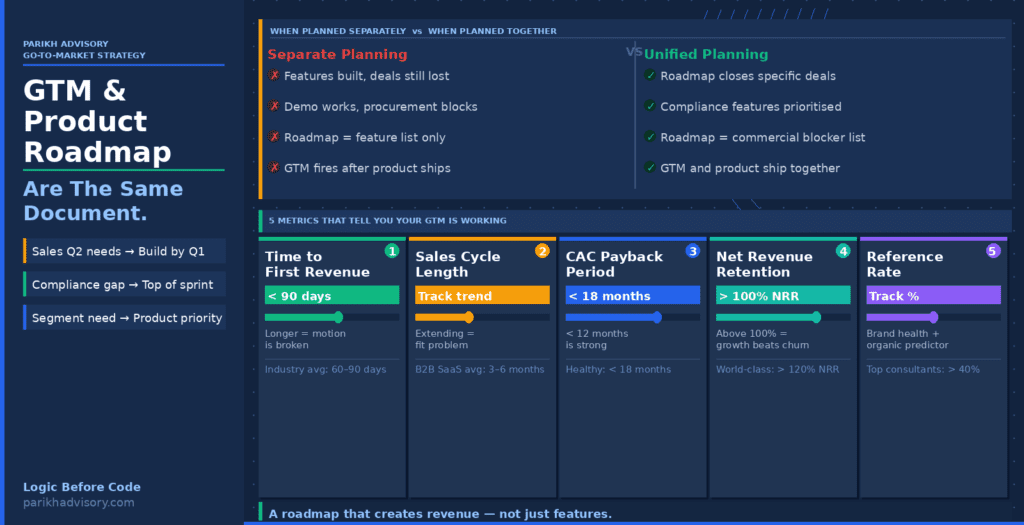
Your GTM calendar and your product roadmap should be the same document.
What does your sales team need to say in Q2? Your roadmap should deliver those capabilities by end of Q1. What compliance feature is blocking three enterprise deals? That feature belongs at the top of your next sprint. What does your highest-value customer segment need that you do not currently have? That is your product priority.
When GTM and product are planned separately, you get features that are technically complete but commercially inert — products that demo beautifully but cannot close enterprise deals because they are missing the compliance, reporting, or integration capability the buyer’s procurement team requires. When planned together, your roadmap is structured around closing specific deals and removing specific commercial blockers. That is a roadmap that creates revenue, not just features.
The Metrics That Tell You Your GTM Is Working
Time to first revenue: How long from product availability to first paying customer? Longer than 90 days indicates something in your GTM motion is broken.
Sales cycle length: For your target segment, how long from first contact to signed contract? If it is extending, your qualification process or product-market fit needs attention.
CAC payback period: How long to recover the cost of acquiring a customer from that customer’s revenue? Under 18 months is healthy for B2B SaaS. Under 12 months is strong.
Net Revenue Retention: Are existing customers spending more with you over time? NRR above 100% means existing customers are growing faster than churn.
Reference rate: What percentage of customers would actively refer you to a peer? This is your brand health metric and your most reliable predictor of organic growth.
Vikram Parikh is a Fractional CPO at Parikh Advisory. He has designed and executed GTM strategies for B2B fintech platforms and enterprise software companies across Southeast Asia and India, from pre-seed to Series A.