Your Engineers Are Not Mind Readers: The Real Cost of Poor Product Documentation
The Illusion of Shared Understanding
There is a particular kind of meeting that happens in product teams everywhere. A product manager explains a feature — verbally, enthusiastically, with lots of hand-waving. The engineering lead nods. The designer nods. Everyone nods. The meeting ends, and everyone leaves with a completely different mental model of what is going to be built.
Three weeks later, engineering demos the feature. And it is not wrong, exactly — it is just not what the product manager meant. The edge cases are not handled. The error states are missing. The business rule that only applies to enterprise clients is applied to everyone. This is not a failure of engineering ability. It is a failure of product documentation. The engineering team built what they understood. The product manager failed to write down what they actually meant.
This failure has a measurable cost. In my experience across 100+ product teams and 150+ product lifecycles, insufficient product documentation manifests in five ways: rework cycles, sprint overruns, defect rates, post-launch compliance failures, and — most expensively — the erosion of engineering trust in the product function.
What Product Documentation Is (And What It Is Not)
Product documentation is not a bureaucratic artefact. It is the written translation of business logic into a format that engineering teams can build from without interpretation.
The key word is ‘without interpretation.’ If your engineering team has to interpret your requirements — to make assumptions, to fill in gaps, to decide what you probably meant — you do not have documentation. You have a brief. Briefs are starting points, not build specifications. Good product documentation answers five questions for every feature:
- What is this feature supposed to do, and why does it exist?
- Who does it apply to, and under what conditions?
- What are all the states and scenarios — including edge cases, error states, and failure modes?
- What are the business rules that govern its behaviour?
- How will we know it has been built correctly?
| If your engineering team has to interpret your requirements, you do not have documentation. You have a brief. Briefs produce guesses. Documentation produces products. |


The Compliance Case for Documentation
In regulated industries — fintech, healthcare, insurance — product documentation is not just an operational practice. It is a compliance requirement. When a regulator conducts an audit, they are not asking to see your code. They are asking to see your documented business logic, your documented decision rules, your documented data handling procedures.
The question that consistently determines audit outcomes is: can you show, in documented form, the business logic that governed every decision your system made? If the answer is ‘it is in the code,’ the audit gets more difficult. If the answer is ‘here is the business rules document, here is the decision table, here is the audit trail,’ the process moves faster. Documentation is your evidence that your product was built intentionally, with deliberate logic that can be reviewed, challenged, and defended.
Hierarchy of Product Documentation
- Business Requirements Document (BRD)
- Functional Requirements Document (FRD)
- User Stories and Acceptance Criteria
- Process Flows and BPMN Diagrams
Business Requirements Document (BRD)
The BRD operates at the business level. It describes what the business needs to achieve and why — in terms of business outcomes, not technical solutions. A BRD for a loan onboarding feature does not describe API calls. It describes the business process: which applicant types are eligible, what data is required from each, what decisions are made at each step, and what the outcome looks like for each possible path. The BRD should be reviewable and signable by someone who does not write code.
Functional Requirements Document (FRD)
The FRD translates the BRD into functional behaviour — what the system must do, screen by screen, flow by flow, condition by condition, to deliver the business outcomes described in the BRD. A well-written FRD includes decision tables for complex business rules, state diagrams for multi-step flows, and explicit documentation of every error condition and its handling. The FRD is the bridge between business intent and engineering specification.
User Stories and Acceptance Criteria
User stories are the unit of work engineering teams build in sprints. Each story should be traceable back to a requirement in the FRD, and each story should have explicit acceptance criteria — specific, testable conditions that define when the story is done.
‘The user can submit their application’ is not an acceptance criterion. ‘When the user clicks Submit, the system validates all required fields and either advances the application to the review queue or displays specific validation errors for each incomplete field, without clearing previously entered data’ — that is an acceptance criterion.
Process Flows and BPMN Diagrams
For any feature involving a multi-step process, a visual process flow diagram is not optional. It is the fastest way to identify gaps and edge cases in the logic, and the most efficient way to communicate complex conditional logic to engineering teams. BPMN (Business Process Model and Notation) is the standard I use for complex process documentation. It is learnable in a day and produces diagrams both business and engineering stakeholders can read and critique.
Why Engineering Teams Lose Faith in Product Functions
Every engineering team I have worked with has a version of the same complaint: product gives them requirements that are incomplete, change mid-sprint, or fail to account for scenarios that engineering then has to resolve on the fly.
The consequence is not just rework. Engineering teams start building in assumptions and buffers that product never asked for, because experience has taught them that requirements will be incomplete. Sprints expand. Velocity drops. The relationship between product and engineering — which should be collaborative and high-trust — becomes adversarial. The fastest way to rebuild engineering trust is to show up with complete documentation. When engineering knows product has done the thinking before the sprint starts, everything moves faster.
A Practical Documentation Standard for Product Teams
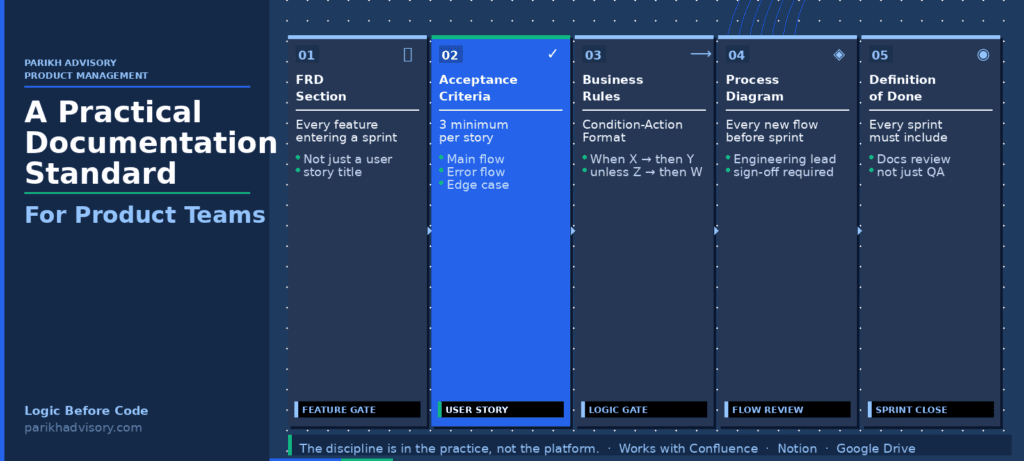
If your team does not have a documentation standard, here is a baseline that works in practice:
- Every feature going into a sprint must have an FRD section or equivalent — not just a user story title
- Every user story must have at least three acceptance criteria: main flow, error flow, and edge case
- Every business rule must be expressed as a condition-action statement: ‘When X, then Y; unless Z, then W’
- Every new flow must have a process diagram reviewed by at least one engineering lead before sprint start
- Every sprint must have a Definition of Done that includes documentation review, not just QA sign-off
None of this requires expensive tools. A well-structured Confluence space, Notion, or disciplined Google Drive can hold all of this. The discipline is in the practice, not the platform.
The Compounding Value of Good Documentation
The immediate value is fewer rework cycles and faster sprint delivery. The compounding value — the value that builds over time — is institutional memory. When a product manager leaves, their documentation stays. New team members can understand why features were built the way they were. When a compliance audit happens, the documentation is already prepared. When you are fundraising and an investor asks how your product handles a specific scenario, you can show them documented logic rather than asking your CTO to explain it in a meeting.
Documentation is not a project management discipline. It is an organisational asset. Treat it like one.
Vikram Parikh is a Fractional CPO at Parikh Advisory. He has written and reviewed BRDs, FRDs, and product specifications across 150+ product lifecycles in fintech, eCommerce, insurance, and supply chain.