
The business situations in this article are fictional illustrations, not accounts of Parikh Advisory client engagements.
“Customers should be able to cancel.” The founder thinks the requirement is clear. The developer pictures a button. Operations thinks about a request that needs approval. Finance asks whether a paid order should be refunded. All four are describing a different system.
Illustrative scenario. A useful brief does not have to predict every future feature. It does need to settle the business decisions that make the first customer journey work. The quickest way to expose disagreement is to take one actual type of transaction from beginning to end, including what happens when it fails.
Explain the decision before the screen
Begin with the person and task: which customer can cancel which order, at what point, and for what reason? State the outcome from that person’s perspective. Then define the business boundary: when does cancellation become a request rather than an immediate action, and who has authority to decide? A wireframe can show where the button sits. It cannot decide policy.
An effective brief distinguishes a fact, a proposed rule and an unresolved question. “Our current team manually approves cancellations after dispatch” is a current-state fact to verify. “Allow automatic cancellation before dispatch” is a proposed rule. “Who pays the return shipping after dispatch?” is an open decision. If these are blended into a polished screen, the development team may make policy by accident.
Follow the situation
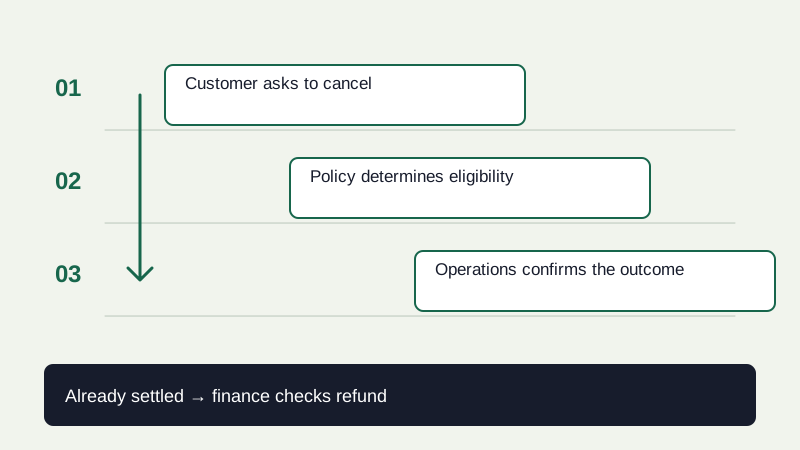
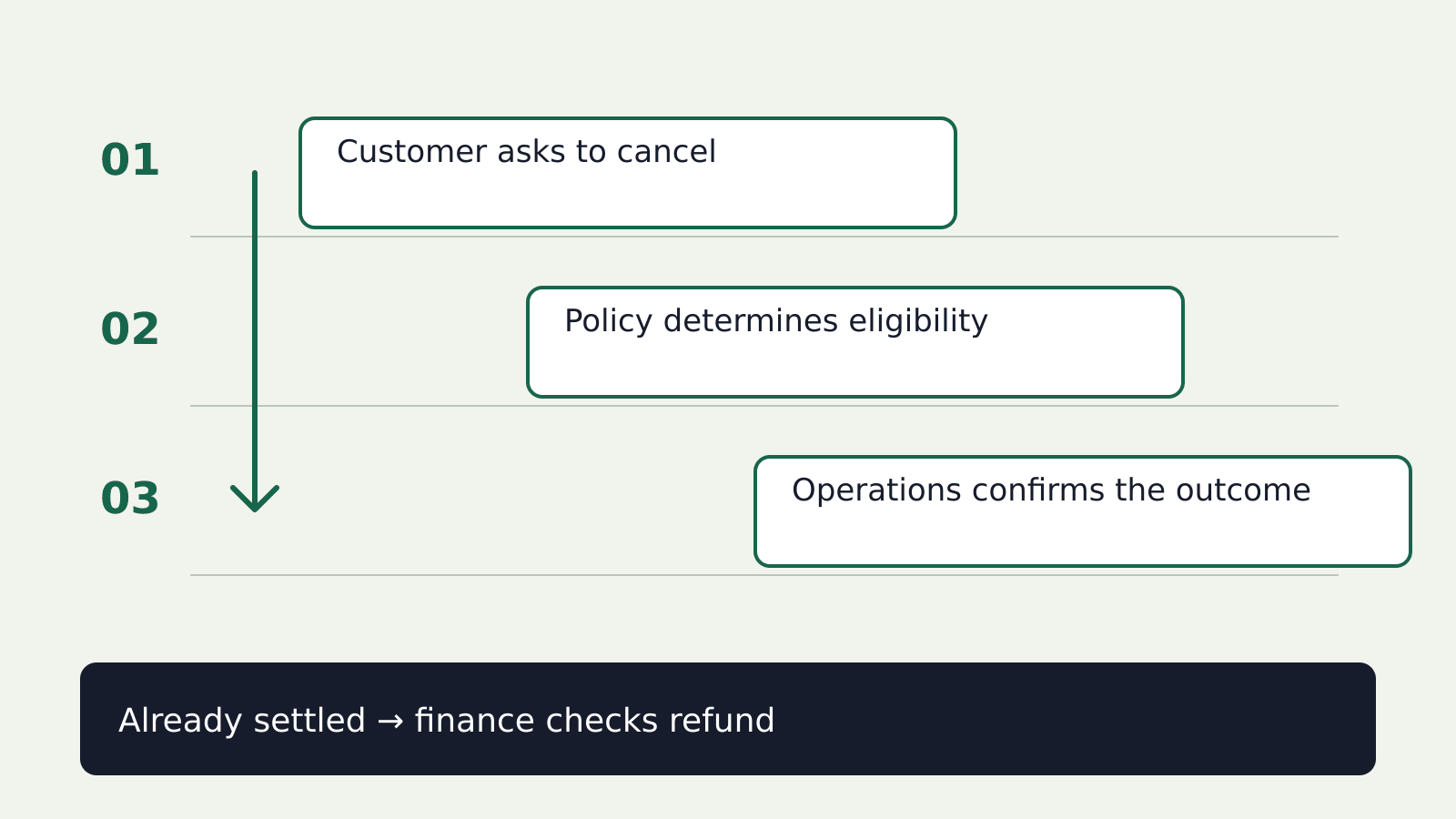
- Customer asks to cancel
- Policy determines eligibility
- Operations confirms the outcome
- Already settled → finance checks refund
Describe a complete example
Walk through one order that has been paid but not dispatched. The customer requests cancellation. Which system knows the payment state? Which system knows dispatch status? Can the request be processed immediately? What confirmation does the customer receive? What happens if the refund provider responds late or sends the same event twice? The brief should show where each state is recorded and who handles an unresolved case.
Now change one condition: the parcel has already left the warehouse. The same button may need to create a return request, explain an ineligible state, or route to an operator. Which response is appropriate depends on the business’s approved policy and applicable obligations. Ask the relevant finance or legal owner to settle those rules before engineering translates them into code.
A short scenario table can carry more meaning than a large feature list:
- Given an eligible paid order that has not been dispatched, when the customer cancels, then the order moves to a defined state, a refund is initiated once, and the customer sees what happens next.
- Given a refund cannot be confirmed, when the provider times out, then the customer sees a pending state and an operator has a route to investigate without creating a second refund.
- Given the order has been dispatched, when cancellation is requested, then the approved post-dispatch policy is applied and explained.
Give developers room to design
A brief should not dictate every implementation choice. The business owns the customer promise, policy, priority and acceptable outcome. The delivery team should propose the interface, architecture and technical handling, then challenge any requirement that is ambiguous, untestable or disproportionately expensive. Agree on the handoff: who decides a policy question, who accepts a trade-off, and what evidence is needed before scope expands.
Include the non-visible requirements that affect the promise: permissions, audit trail, data retention, accessibility, support access and failure recovery where relevant. Do not fill these with generic boilerplate. Explain why each matters for this journey and involve specialists when the stakes require them.
Check that the brief can be tested
Before treating the document as ready, ask someone from operations, finance and delivery to describe the same example independently. If their expected states or responsibilities differ, the brief has found a decision to make. Acceptance criteria should describe an observable outcome, including a negative or delayed path, rather than merely repeat “cancellation works.”
The first release can deliberately cover only a narrow order type or cancellation window. Name the exclusions and what the customer sees when they apply. A smaller promise that can be operated is more credible than a broad button whose exceptions nobody owns.
Compare the next moves
- Actors: Identify who requests, approves and executes.
- Rules: Define deadlines, refund conditions and exceptions.
- Acceptance: Demonstrate both allowed and refused cancellations.

A brief the team can use
- One sentence naming the user, task and consequence of the current difficulty.
- Two or three representative scenarios, including a failure or exception.
- The approved policy decisions, with owners for open questions.
- Observable acceptance conditions and the boundary of the first release.
- The data, external dependencies and operating roles needed to keep the promise.
Method reference: the UK Government Service Manual on user stories connects user need with acceptance outcomes; its guidance on learning user needs distinguishes a user’s goal from a solution. The cancellation scenario is fictional and is not legal or implementation advice for a specific business.
Sources & scope
Related primary reading is provided below. The decision framework and fictional examples are Parikh Advisory’s analysis; these references do not establish that the illustrated events occurred.
- Understand users and their needsUK Government Digital Service