The business situations in this article are fictional illustrations, not accounts of Parikh Advisory client engagements.
A founder asks three firms for a customer portal. The cheapest quote excludes migration and support. Another assumes the founder will supply integration specifications. The third includes discovery but leaves the eventual build price open. The totals cannot be compared until the promises and exclusions are aligned. You do not need to write code to ask the questions that make the decision safer.
Normalize what is being bought
Write a one-page comparison of the user outcomes and key journeys each proposal covers. Which roles can access which data? What happens with an incomplete application or failed payment? Identify integrations, migration, hosting, security testing, accessibility, training and post-launch support. Mark each as included, excluded or undecided. A low bid can be sensible, but an unknown is not a free feature.
Follow the situation
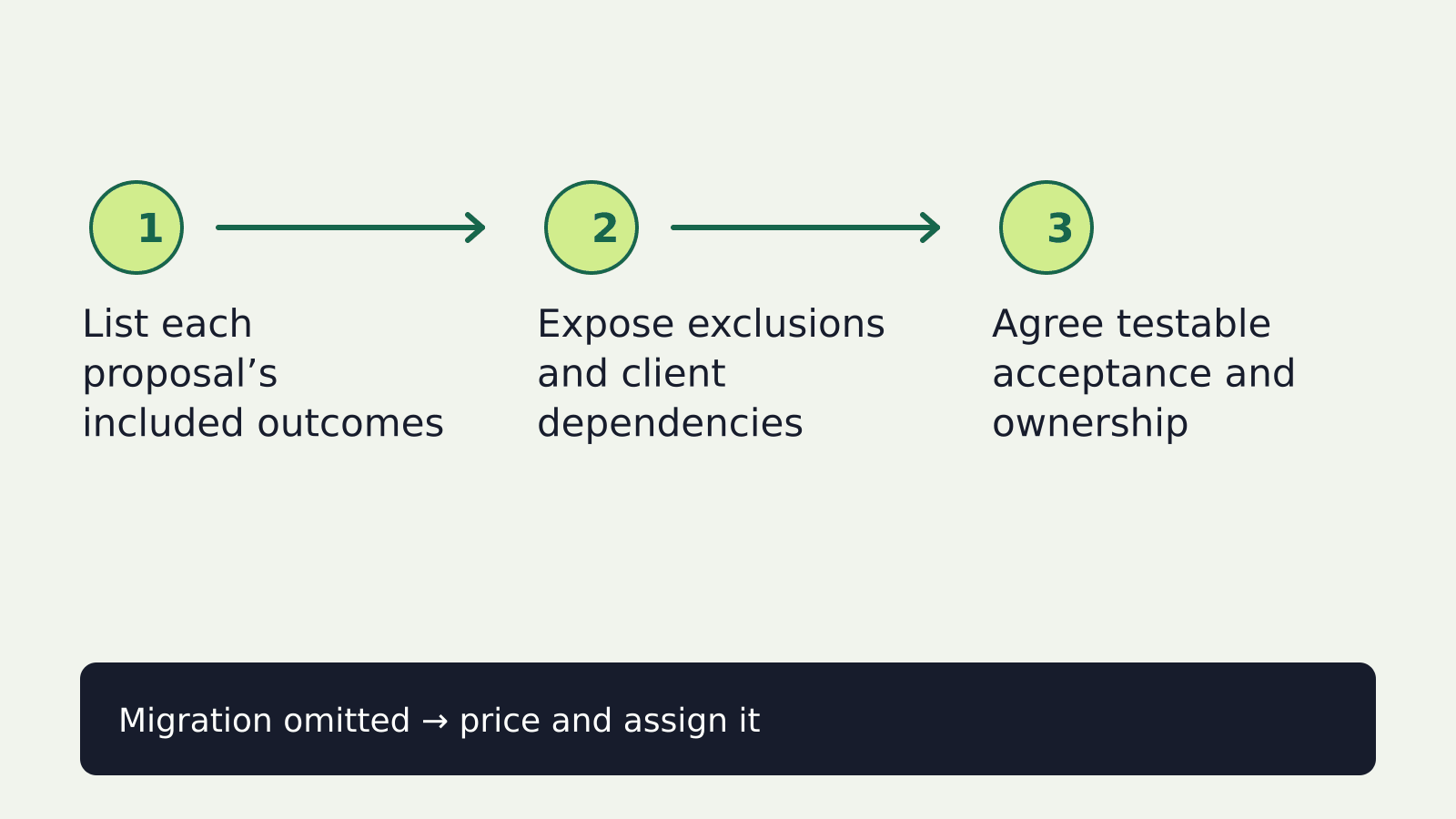
- List each proposal’s included outcomes
- Expose exclusions and client dependencies
- Agree testable acceptance and ownership
- Migration omitted → price and assign it

Ask for acceptance evidence
Request examples of how completion will be demonstrated for the most important journey, including an error path. Clarify who supplies test data and approves the result. “Portal delivered” is too broad to settle a disagreement at handover. Ask how defects will be classified and corrected, what documentation will be provided, and what happens when a third-party integration changes. These questions expose assumptions without asking the vendor to commit to an impossible guarantee.
Examine ownership and change
Find out who owns source code, design files, accounts, infrastructure, licenses and customer data. Confirm how the business can access and export its data if the relationship ends. Compare the change-request process, rate basis, approval authority and effect on timeline. A fixed fee transfers some estimation risk but usually needs a defined scope; a time-and-materials proposal needs transparent reporting and a budget boundary.
Compare the next moves
- Scope: Compare the same journey, integrations and exclusions.
- Ownership: Clarify source, data, access and maintenance terms.
- Acceptance: Request demonstrations of agreed success and failure cases.

Test the working relationship
Ask each vendor to walk through one real exception from your business, show how they would resolve an unclear requirement and identify the person accountable after launch. Check references relevant to your type of project, not just visual portfolio work. For security-sensitive projects, request the proposed practices and evidence, with an expert review where appropriate. NIST’s secure development framework provides a shared vocabulary for supplier discussions, not a certification of any particular bidder.
A decision to take into the next meeting
Bring one actual case, name its owner and decide what evidence would justify the next investment. If the evidence is missing, make the smallest useful test the next action. Record the choice and the date to review it.
Source note: NIST, Secure Software Development Framework SP 800-218. The example is illustrative; the source informs the method or control discussed, not the imagined business.
Sources & scope
Related primary reading is provided below. The decision framework and fictional examples are Parikh Advisory’s analysis; these references do not establish that the illustrated events occurred.