
The business situations in this article are fictional illustrations, not accounts of Parikh Advisory client engagements.
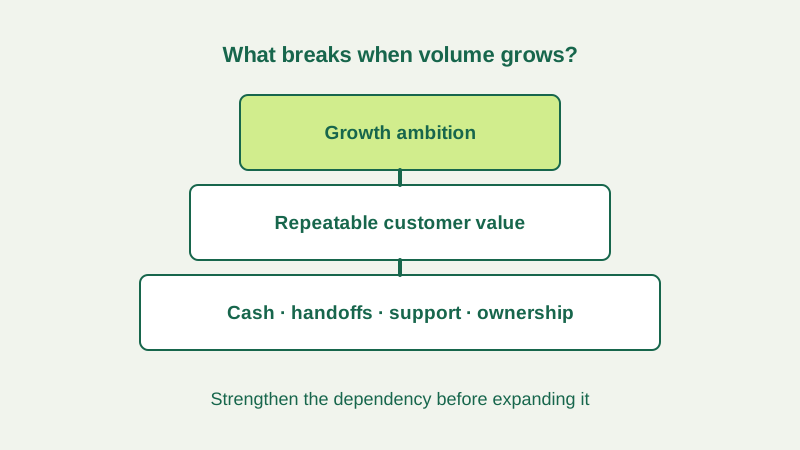
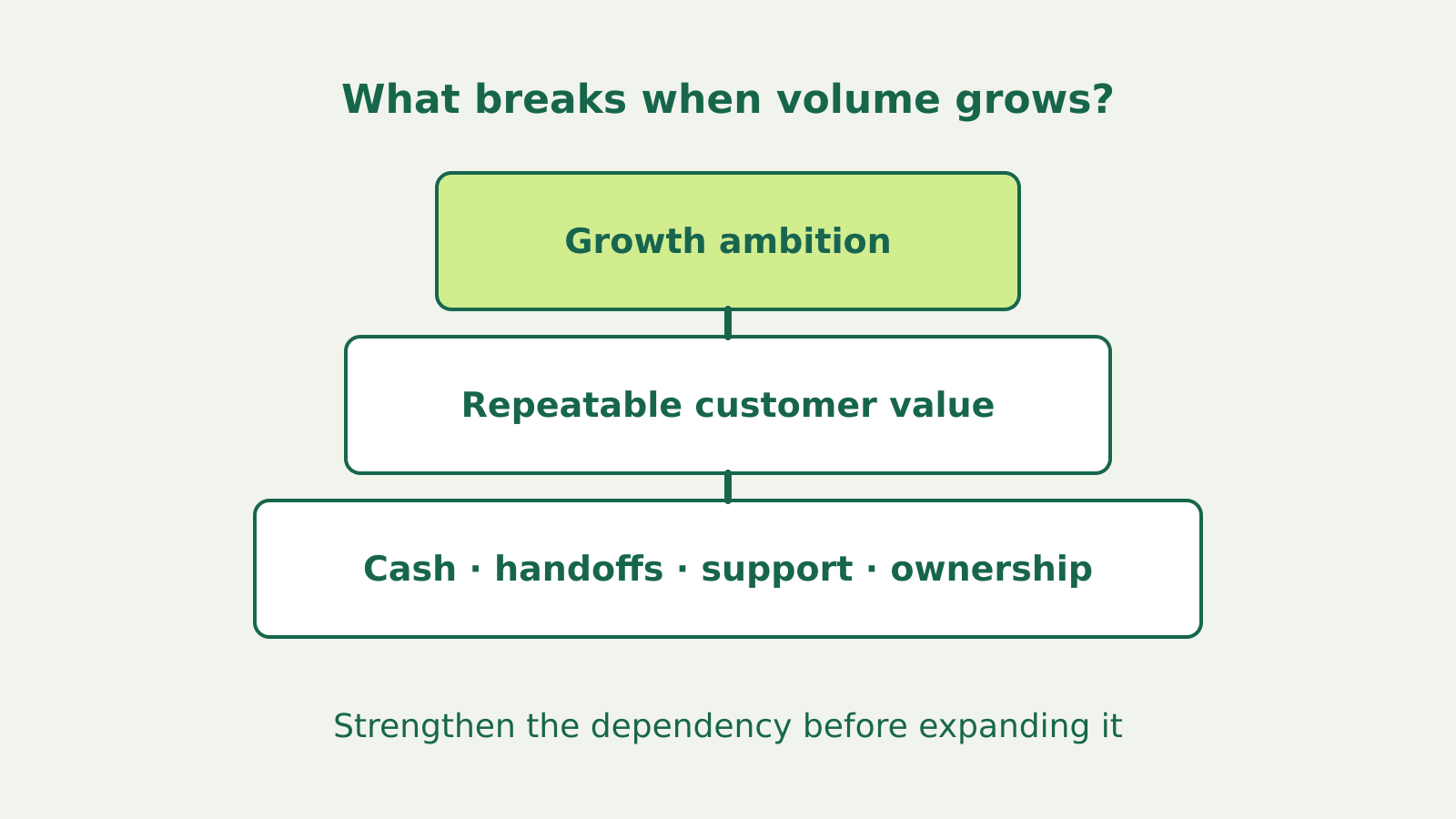
The 2027 plan may contain a new market, more hires and a larger roadmap. Before adding volume, examine what the current business can repeat reliably. A conversion rate built from a handful of enquiries, a founder-managed support queue and a product that only works for early adopters are useful signals, but weak foundations for confident scale projections.
Establish a baseline you trust
Review the last few months by customer segment and cohort: demand, conversion, activation, repeat use, gross margin or contribution where relevant, support effort and time to deliver. State the denominator and sample size. Separate one-off founder interventions from repeatable team behavior. A trend is more useful than an impressive aggregate that conceals where value or cost appears.
Follow the situation
- Review the promises made this year
- Find the constraint that volume amplifies
- Sequence a small set of next-quarter fixes
- More volume, worse service → repair the foundation
Find the constraint scale will amplify
Trace one customer promise end to end. Where does a handoff depend on memory? Which exceptions require the founder? Where does data arrive late or need manual correction? Identify the constraint with both frequency and consequence. Fixing an unreliable fulfilment step can have more value than launching another acquisition channel that feeds it more work.
Choose a small set of bets
Write three categories: stabilize what already sells, test a growth hypothesis, and build a capability needed for the next stage. Name owners, resources and evidence gates for each. A new segment should have an explicit buyer and acquisition path; a new hire should remove a defined bottleneck. Keep capacity for operating the existing business and for surprises.
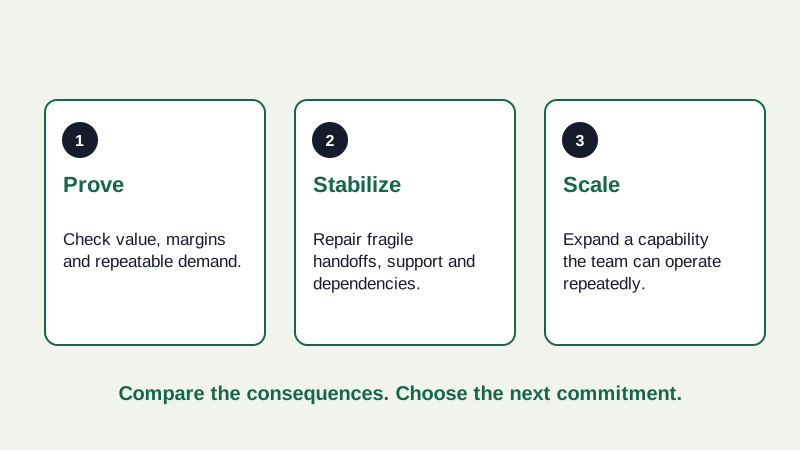
Compare the next moves
- Prove: Check value, margins and repeatable demand.
- Stabilize: Repair fragile handoffs, support and dependencies.
- Scale: Expand a capability the team can operate repeatedly.
Make the plan revisable
Decide in advance what would cause you to accelerate, pause or stop each bet. Review monthly or quarterly using actual outcomes, not only project completion. A successful feature shipment does not establish retention; a signed partnership does not establish profitable demand. The year plan should make uncertainty visible and protect the ability to change course without treating every adjustment as failure.
The next decision
Put one growth bet and its evidence gate beside the operating constraint it will stress, then assign the decision owner.
Source note: GOV.UK Service Manual, planning in agile. Examples are illustrative; the linked source supports the decision method, not the hypothetical business.
Sources & scope
Related primary reading is provided below. The decision framework and fictional examples are Parikh Advisory’s analysis; these references do not establish that the illustrated events occurred.
- Understand users and their needsUK Government Digital Service