
The business situations in this article are fictional illustrations, not accounts of Parikh Advisory client engagements.
The founder’s calendar has become the roadmap. Customer calls, pricing questions, release decisions and disagreements about what to build all wait for an open slot. The developers can deliver, but the team cannot choose a direction without the founder.
Illustrative scenario. This may call for a Head of Product. It may also call for clearer decision rights, a capable product manager, or a founder who reserves time for product decisions. A senior title is useful only if there is a sustained leadership job and the organization is prepared to let that person do it.
Find the work behind the bottleneck
List the last ten product decisions that stalled. Were they about which customer to serve, which outcome mattered, whether evidence was sufficient, how a policy should work, or how to coordinate delivery? Who had the relevant information, and why could they not decide? A founder may be holding genuinely strategic choices while also approving routine changes that could be delegated.
Then ask whether the problem is temporary or recurring. One launch may need a focused specialist. A growing set of products, teams and customer segments may need someone to connect strategy, discovery, investment and people development over time. Hiring a leader to write tickets leaves the original decision bottleneck intact.
Follow the situation
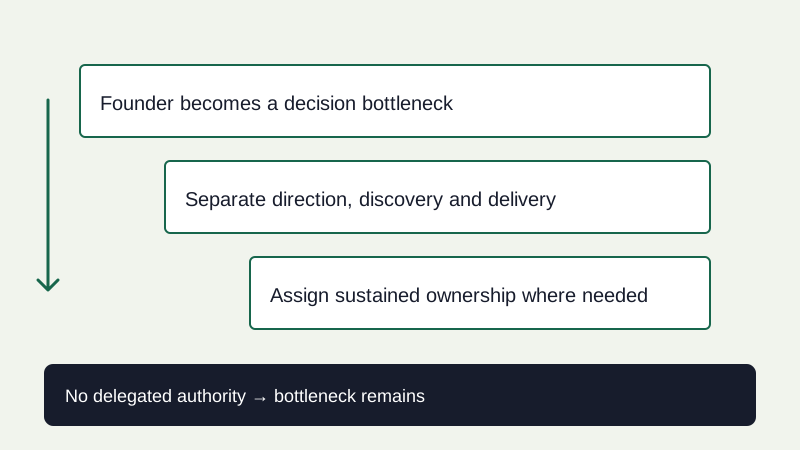
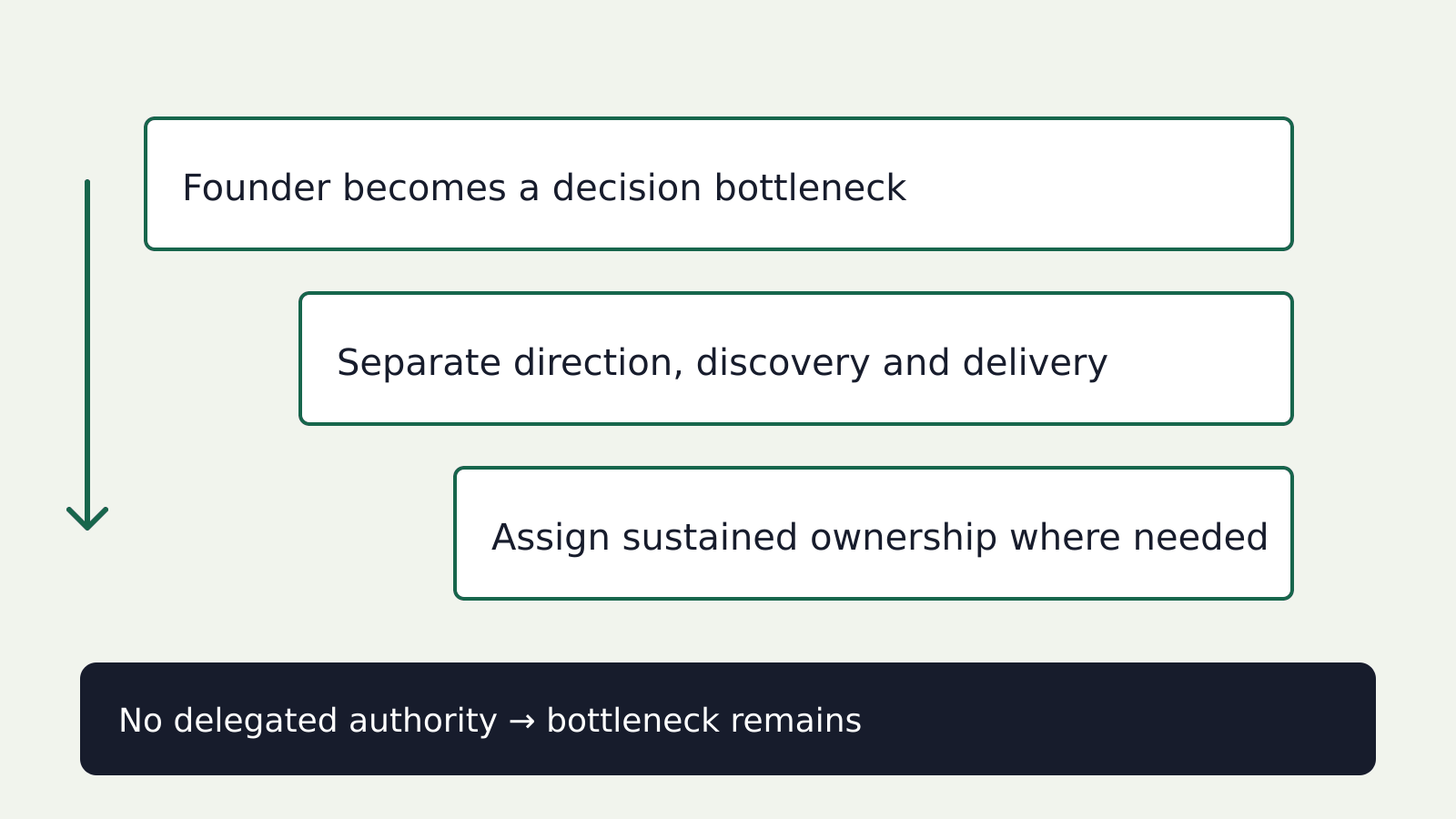
- Founder becomes a decision bottleneck
- Separate direction, discovery and delivery
- Assign sustained ownership where needed
- No delegated authority → bottleneck remains
Authority is part of the role
A Head of Product cannot own outcomes without access to customers, commercial data, engineering and the budget discussion. Decide which choices the founder retains, which the leader can make, and which require joint approval. Clarify who can stop a weak initiative or redirect capacity when evidence changes. If every important call still returns to the founder, the title may add a meeting layer rather than relieve the bottleneck.
The mandate must also fit the team. If there are several product managers, developing their judgment and aligning work may be central. If there is one small team, a hands-on product leader may still do discovery and product work directly. The company should not hire a large-company executive job description for a small-company operating reality.
Compare alternatives honestly
- Founder-led product with a stronger cadence: Appropriate when product direction is still inseparable from the founder’s market learning and the decision load is manageable. Delegate routine calls and protect time for customer evidence.
- Product manager or lead: Appropriate when a defined area needs continuous discovery and delivery coordination, with strategic choices and people leadership still owned elsewhere.
- Fractional leadership: Can establish a decision rhythm and help with strategic trade-offs for agreed capacity, if the team can act between sessions and the mandate is explicit.
- Full-time Head of Product: Appropriate when sustained cross-team leadership, hiring and investment decisions justify the cost and the founder is ready to share authority.
Cost is not only salary or retainer. Consider ramp-up, management attention, continuity and what happens if the person leaves. A fractional arrangement can be a bridge, but it cannot create unlimited availability or replace a full-time manager for daily issues.
Test the mandate before recruiting
Write a one-page charter: the outcomes the role owns, decisions it can make, evidence it can access, teams it works with and how success will be reviewed. Use the recent stalled decisions as interview cases. Ask candidates how they would investigate, which decision they would take and where they would involve the founder. Their answer will reveal more than a generic roadmap presentation.
The founder can test a narrower delegation immediately: assign a product decision with a clear boundary and review what happened. If every choice still needs founder approval because no one trusts the data or the commercial goal is unclear, fix that operating condition alongside recruitment.
Compare the next moves
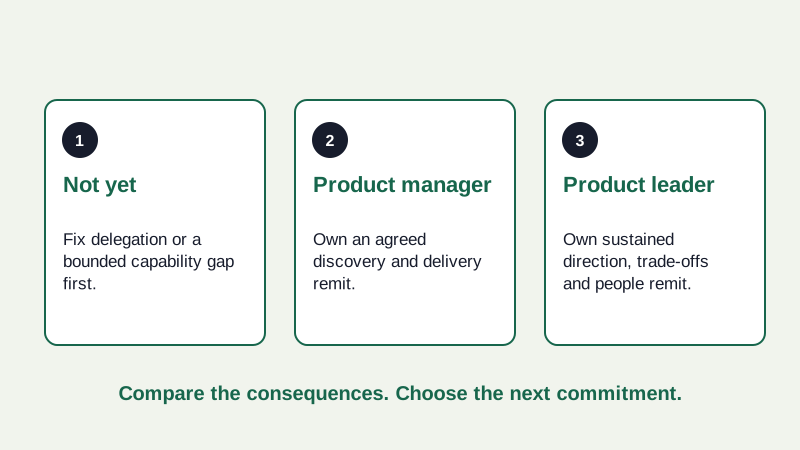
- Not yet: Fix delegation or a bounded capability gap first.
- Product manager: Own an agreed discovery and delivery remit.
- Product leader: Own sustained direction, trade-offs and people remit.
The decision
A Head of Product becomes useful when product leadership is a sustained job that the founder cannot perform well enough alongside the rest of the business, and when the new leader can genuinely own the agreed decisions. The threshold is not a headcount milestone. It is the combination of recurring judgment, organizational complexity and authority to act.
Research note: Silicon Valley Product Group argues that founders often play the product role in early-stage companies, while its role discussion distinguishes product leadership from individual product management. These are practitioner perspectives, not a universal staffing rule.
Sources & scope
Related primary reading is provided below. The decision framework and fictional examples are Parikh Advisory’s analysis; these references do not establish that the illustrated events occurred.
- Understand users and their needsUK Government Digital Service