
The business situations in this article are fictional illustrations, not accounts of Parikh Advisory client engagements.
An underwriter reviews an application that sits near a credit threshold. The income evidence has changed and one document cannot be read automatically. Engineering asks whether the system should decline, hold or refer it. Risk says “refer”; operations says “hold.” Both answers sound plausible, but neither has an agreed owner, evidence standard or next state.
Illustrative scenario. A threshold is only one part of a credit decision. The product must represent the policy, missing information, human authority and subsequent customer communication. Coding the easiest interpretation first can make an unresolved business decision look settled.
A rule is a decision with an owner
Start with the policy question, not the condition in a code branch. Which applicants and products does the rule cover? What evidence is required? Who approved the criterion? When does it take effect? What outcome follows if the evidence is missing, conflicting or stale? The answers should come from the responsible credit and compliance functions under the applicable regime, with product and engineering translating them into a workable journey.
A simple decision table exposes gaps. For example, a complete application meeting defined criteria may proceed to the next approved step; an incomplete one may request information; a potential policy exception may require a named human review; an ineligible one may be declined with the appropriate explanation. These are illustrative states, not a recommended lending policy. The actual thresholds, reasons and notices must be set by qualified owners.
Follow the situation
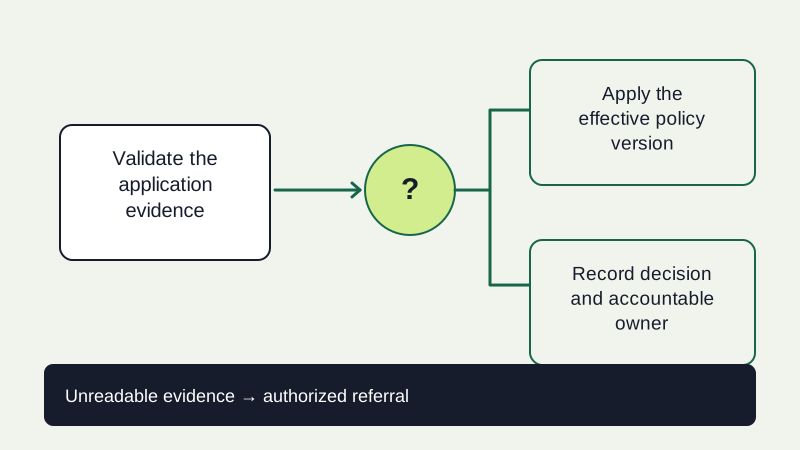
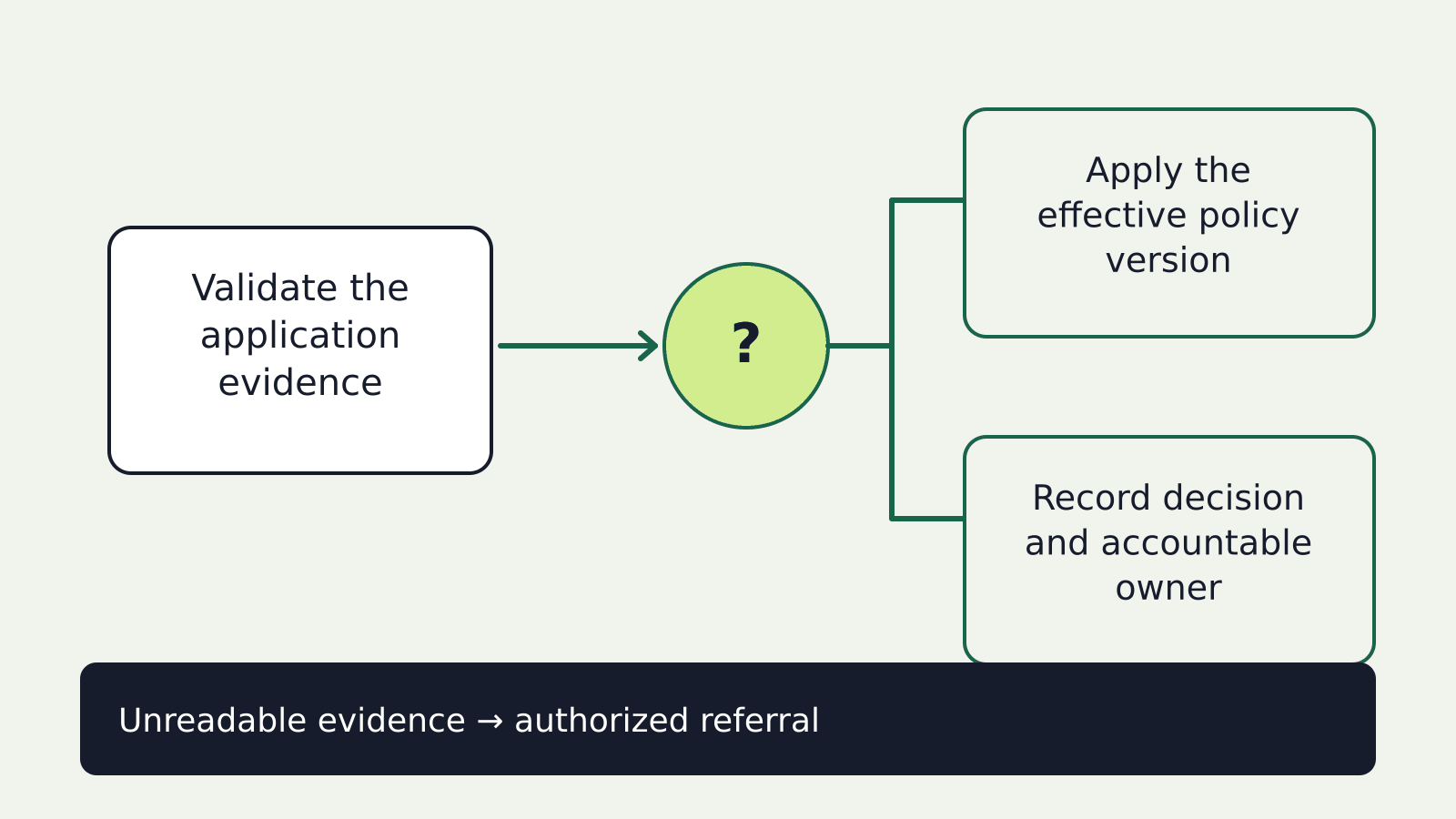
- Validate the application evidence
- Apply the effective policy version
- Record decision and accountable owner
- Unreadable evidence → authorized referral
Design the exception before it becomes a workaround
The borderline application should have a visible state and a route to resolution. If a human may override an automated recommendation, define the permitted role, grounds, evidence, second review if required, and what is recorded. If no override is allowed, the interface must not imply one. A manual queue without an owner or service expectation can become an invisible backlog.
Consider the borrower as well. A customer may see “application complete” while the lender is waiting for evidence or a decision. Those statements describe different things. Product copy should communicate the true customer-facing status without exposing sensitive control logic or promising an approval that has not occurred.
A rule also needs a life after launch. Record its version, effective date, approving authority and affected applications. When policy changes, test boundary cases, existing applications in flight and the treatment of decisions made under the earlier version. An audit trail should make it possible to reconstruct the basis of a decision without relying on a developer’s memory.
Test the policy as a system of cases
A single happy path cannot validate a credit decision workflow. Ask the relevant owners to provide examples of complete, incomplete, conflicting, duplicate and borderline applications. Test what happens when a third-party data source is unavailable, a reviewer is absent, an applicant corrects information, or a decision is challenged. For each case, identify the state, owner, evidence, communication and exit condition.
The test should include operational capacity. A policy that routes every ambiguous case to a specialist may be sound in principle but unworkable at expected volume. Estimate the queue and turnaround with real or carefully stated assumptions. If the volume is unknown, run a bounded simulation rather than treating the initial manual path as a scalable solution.
What belongs in the product brief
- The approved policy source and accountable owner for each decision.
- A decision table for normal, missing-data and exception states.
- Authority and evidence for manual review or override.
- Versioning, effective date and treatment of in-flight cases.
- Customer-facing status, escalation and record of the final decision.
- Tests for boundary cases, provider failure and policy changes.
The point is not to freeze a policy forever before engineering begins. It is to know which rules are approved, which are still hypotheses, and who can change them. Teams can iterate safely when the decision mechanism and accountability are explicit.
Compare the next moves
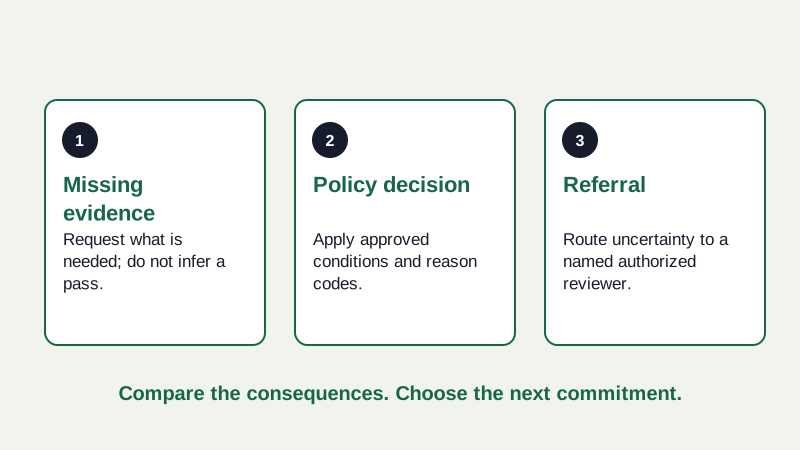
- Missing evidence: Request what is needed; do not infer a pass.
- Policy decision: Apply approved conditions and reason codes.
- Referral: Route uncertainty to a named authorized reviewer.
Where this guidance stops
The Basel Committee’s 2025 credit-risk principles address banks and emphasize written credit policies, assigned approval responsibilities and exception processing. They provide useful governance context for this article; they are not a universal product specification for every FinTech company. The applicable legal, regulatory and credit-policy requirements depend on the entity, activity and jurisdiction. Obtain specialist review before putting a lending decision into live use.
In the opening case, the engineer’s question is a valuable signal. The next action is to resolve the policy and ownership gap with the people accountable for credit decisions, then test the resulting states. The code can implement that decision; it should not silently make it.
Sources & scope
Related primary reading is provided below. The decision framework and fictional examples are Parikh Advisory’s analysis; these references do not establish that the illustrated events occurred.
Educational product and operating analysis. Applicable legal, financial, risk and compliance requirements need qualified review for the specific activity and jurisdiction. This article does not certify launch readiness or compliance.