SHAIYAA / BUSINESS & DIGITAL STRATEGY
A conversation to buy.
A system to support it.
How a Jaipur home-linen brand made purchasing more personal—and connected the business around it.
The website became a place to discover. WhatsApp became the intended place to ask, choose and confirm. Customer accounts, history and operational information supported the experience behind the scenes.
Explore the decision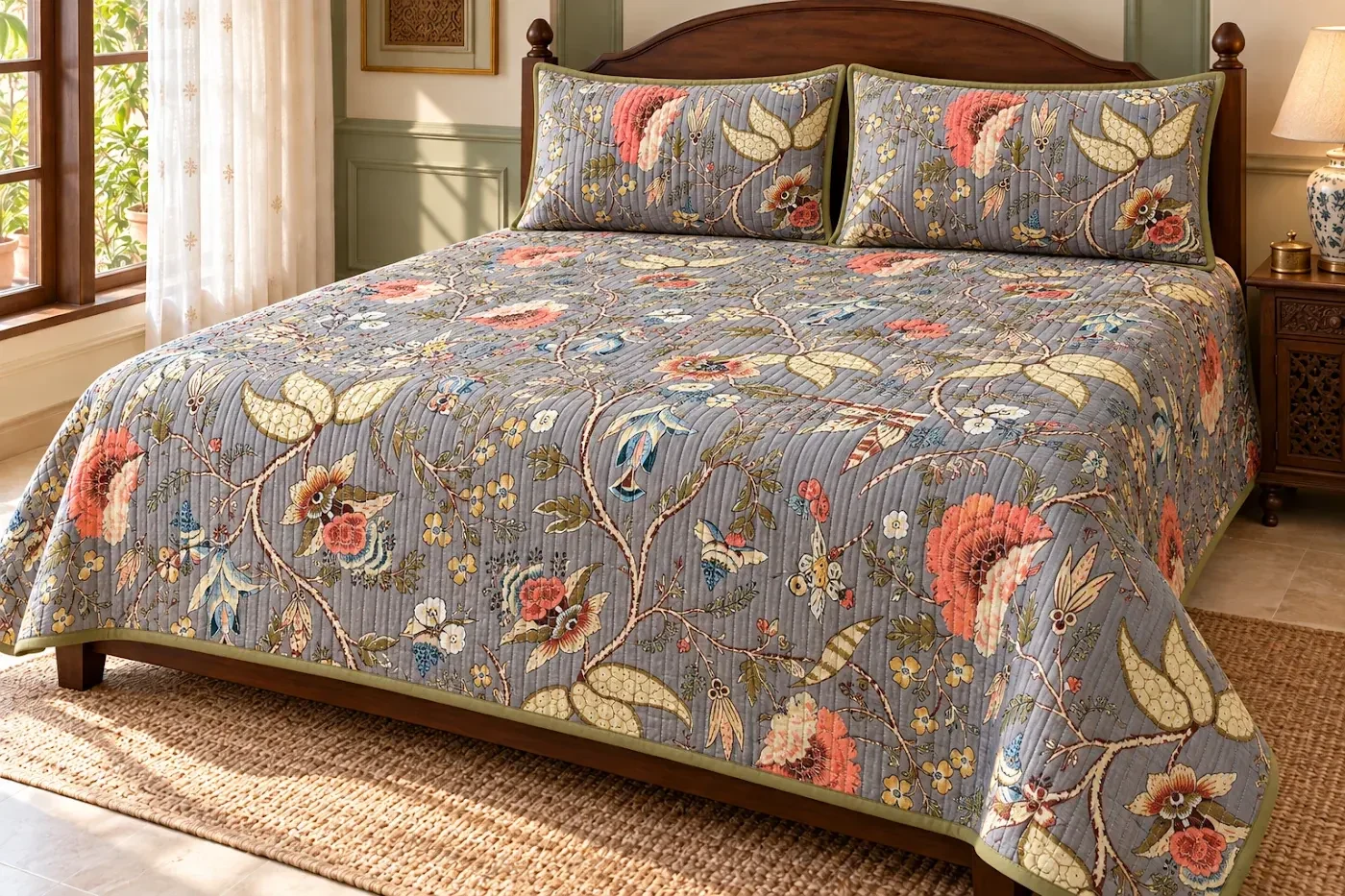
Buy with guidance.Shaiyaa catalogue imagery
The first reported nine days.
Founder-reported · early operating evidenceReported by the founder for the first nine-day period. Exact reporting dates and underlying records have not been independently checked. Read the evidence boundaries ↗
01 THE BUSINESS BEHIND THE DECISION
A product choice can
start with a question.
Shaiyaa sells bedsheets, quilts, dohars, bed covers, dining linen and lifestyle products. Size, fabric, print and availability all influence the buying decision.
For a customer, “the right bedsheet” is not just a photograph. It is the finished size, the mattress depth, the fabric, the matching pillow covers—and whether the preferred design is available.
The business combines a small stockholding with supplier-supported choice. Human guidance was already part of selling. The opportunity was to make the digital journey reflect that reality.
Different sizes, materials and designs.
Questions before a purchase decision.
Returning customers and past purchases.

“Will the finished size fit my bed?”
“Which fabric suits what I need?”
“Is this print available?”
Question prompts—not customer-message screenshots.02 THE ASSUMPTION CHALLENGED
An online shop does not
have to end at a checkout.
The question was not whether a cart is useful in general. It was whether a conventional checkout matched how Shaiyaa’s customers already bought.
“If we sell products online, customers should be able to check out online.”
Conversations about selection and availability were already happening. Keeping the cart did not remove that work.
The decision: make guidance part of the journey, then connect the information around it.This was a fit-for-business decision. It does not establish that conversational purchasing will outperform checkout for every retailer—or that it has caused a conversion uplift at Shaiyaa.
03 THE CUSTOMER JOURNEY
A clear hand-off.
Not a dead end.
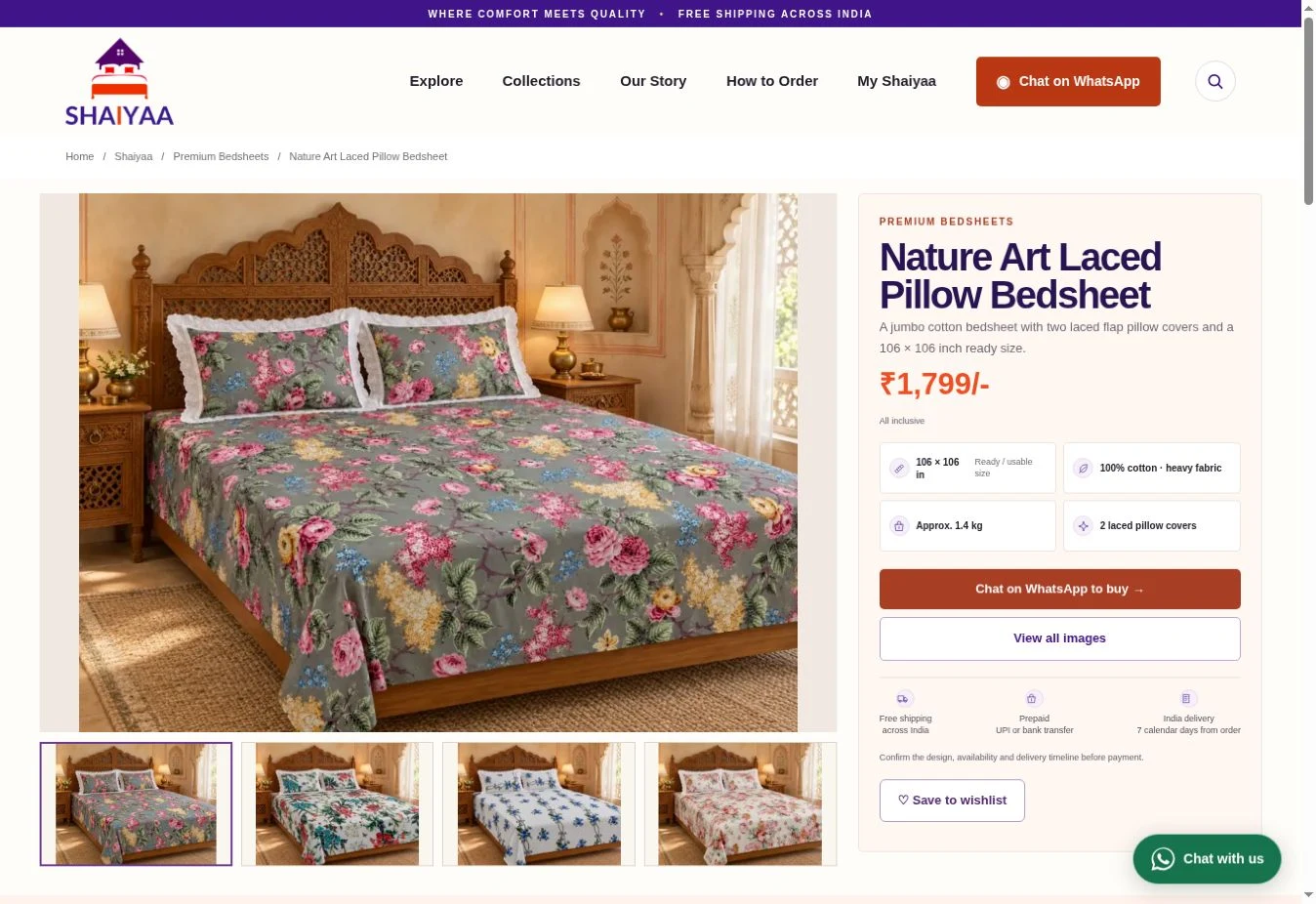
Product discovery remains on the website. A contextual WhatsApp link helps the customer continue the conversation without starting from a blank message.
The website introduces the range and helps a customer find a relevant starting point.
04 THE CONNECTED BUSINESS
Less checkout.
More continuity.
The important change sits behind the purchase: connecting customer context, conversations, account history and operational information.
Human guidance stays part of buying.
A shared reference across the relationship.
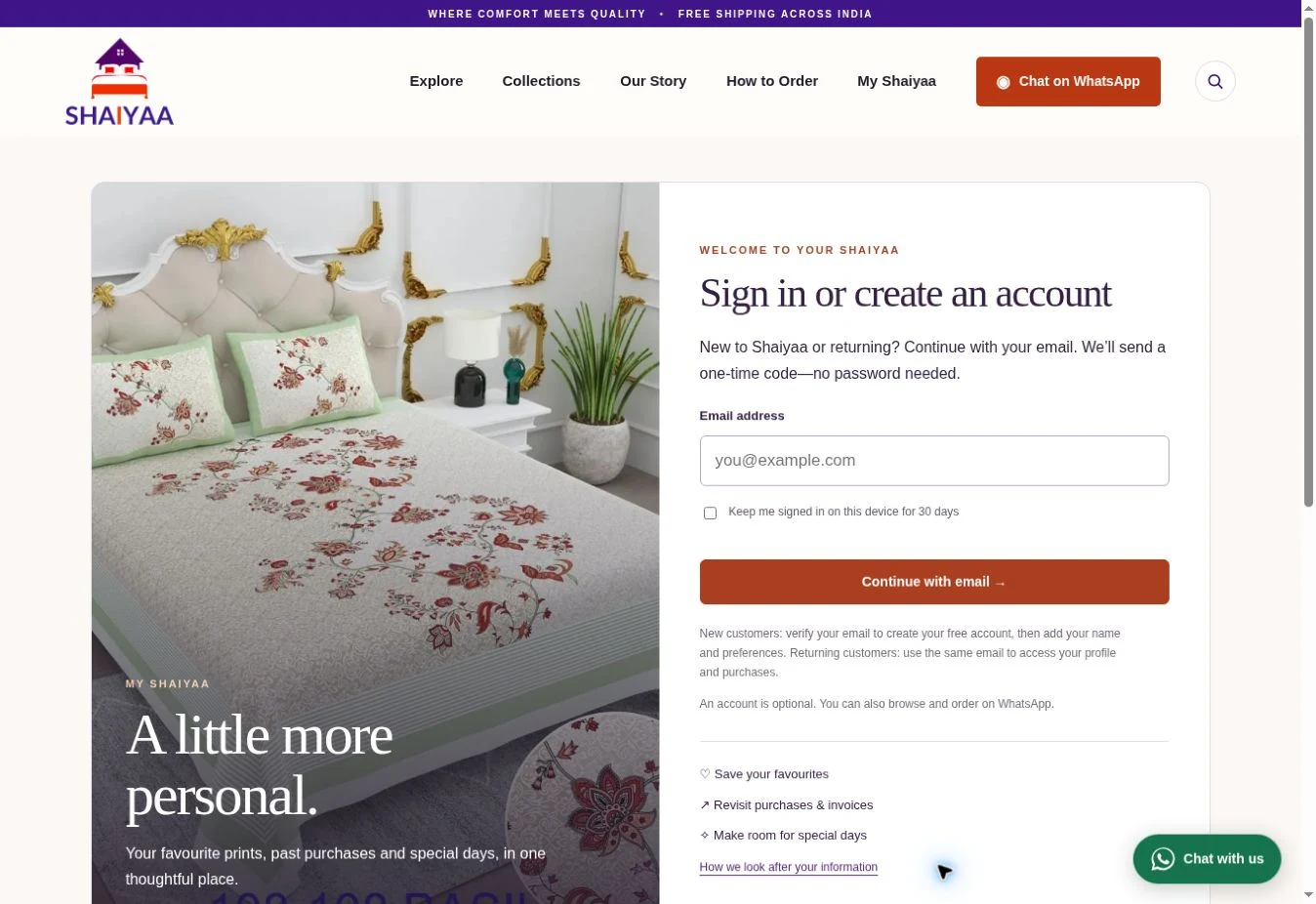
Optional sign-in, saved details and a place to return.
Past purchases and invoices within the reported coverage.
Reported catalogue, sign-in and order traceability.
A reported view of customer activity and operational status.
Operating-model map based on the founder’s account—not a dashboard screenshot. End-to-end linkage, record completeness and access controls require technical QA.
AN ACCOUNT IS OPTIONAL
Keep the relationship.
Remove the extra hurdle.
Customers can browse and order on WhatsApp without first creating an account. The public My Shaiyaa entry offers email-code sign-in and describes access to favourites, purchases and invoices.
These describe the reported system context. They are not 203 newly acquired customers or six years of results from the redesigned website.
05 EARLY OPERATING EVIDENCE
Encouraging.
Not yet conclusive.
The founder’s first nine-day account reports 22 units sold and five purchasing customers from six enquiries, with enquiries answered within 15 minutes.
ENQUIRY → PURCHASING CUSTOMER
83.3%5 purchasing customers ÷ 6 reported enquiries
Five purchasing customers; one enquiry did not result in a reported purchase within the window.A denominator matters.
This is an early enquiry-to-customer conversion rate from a sample of six. It is not the website’s visitor-to-buyer conversion rate.
The 22 units are items sold. They do not represent 22 separate orders or 22 customers.
There is no before-and-after baseline here that establishes cart removal as the cause of a conversion improvement.
| Statement | Evidence status | How to read it |
|---|---|---|
| 22 units sold in nine days | Founder-reported result | Units sold; not separate orders or unique customers. |
| Five of six enquirers purchased | Founder-reported result | Early enquiry-to-customer conversion; small sample. |
| Enquiries answered within 15 minutes | Founder-reported service performance | Not independently audited; no average or percentile established. |
| 203 customer accounts; six years of history | Founder-reported system context | No claim that every account is active or every historical record is complete. |
| Clicks, sign-ins and catalogue activity are traceable | Reported system capability | Event coverage, identity linkage and completeness need technical QA. |
| Cart removal improved conversion | Not established | No causal comparison or website-wide conversion baseline. |
| No customer ever drops out | Not established | The reported period includes one enquirer without a recorded purchase. |
| Manual workload decreased | Not quantified | Reported as broadly similar to the previous selling process. |
| 500 new customers in twelve months | Business target | An ambition to measure against; not an achieved result. |
Evidence note: operating figures and system counts come from the owner-supplied brief. Public pages were inspected for the customer-facing flow. Underlying sales, enquiry and response-time records were not independently audited. The brief gives a nine-day duration but does not supply exact start and end dates.
06 THE TRADE-OFF
Human work remains.
It has a clearer place.
The most compelling finding is not that manual work disappeared. It is that conversations were already happening—and became an intended part of the purchase journey.
Guidance before commitment.
The customer can resolve selection and availability questions before confirming a purchase. The digital experience supports the conversation rather than pretending it is unnecessary.
Speed, capacity and follow-through.
A person still answers, checks and guides. The reported workload is manageable and broadly similar to the prior process, but no reduction in labour time or cost per sale has been measured.
Volume changes the economics.
More enquiries may require better triage, product information and staffing. An encouraging first period does not establish that the same service level is sustainable at a larger scale.
07 THE NEXT TEST
Can the experience hold
as the business grows?
The next phase is to measure the model over a longer period—across acquisition, service effort, repeat purchase and operational reliability.
LOGIC BEFORE CODE
The significant change
was not a missing
checkout button.
It was building a purchasing experience around how customers actually behaved—and connecting the conversations, accounts, history and operational information needed to support it.
The early figures are encouraging. The next question is whether the business can sustain that experience as customer volumes increase.
Design for the business you actually operate.Then choose the technology that supports it.