
The business situations in this article are fictional illustrations, not accounts of Parikh Advisory client engagements.
A customer receives an order confirmation in seconds. Two days later, support cannot say when delivery will happen. Sales considers the order complete; the warehouse says it never received the instruction needed to release it. Each team has a reasonable view of its own step. The customer experiences one unfinished promise.
Illustrative scenario. A workflow map is useful when it follows that promise across people, systems and decisions. It should reveal where information changes hands, where work waits and who knows that an exception has occurred. A polished diagram of the intended process can hide precisely the problem a founder needs to see.
Choose a real start and finish
Begin with a trigger the customer recognizes: an order is placed. End with a meaningful outcome: the goods are delivered and the customer knows the status. Then trace one recent order, using its timestamps, messages and records. Ask each person what they received, what they checked, what they changed, and how they knew the next person had accepted the work.
Map the ordinary path and one awkward case. The warehouse may need an address correction, a stock substitution or a payment confirmation. If the map shows only “sales → warehouse → delivery,” it leaves out the decisions that determine whether the order can move. Include the customer-facing message at each important state, not just the internal system state.
Follow the situation
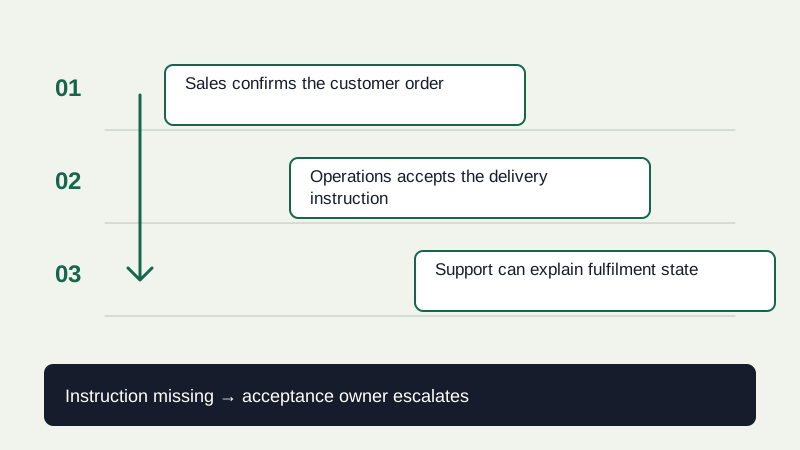
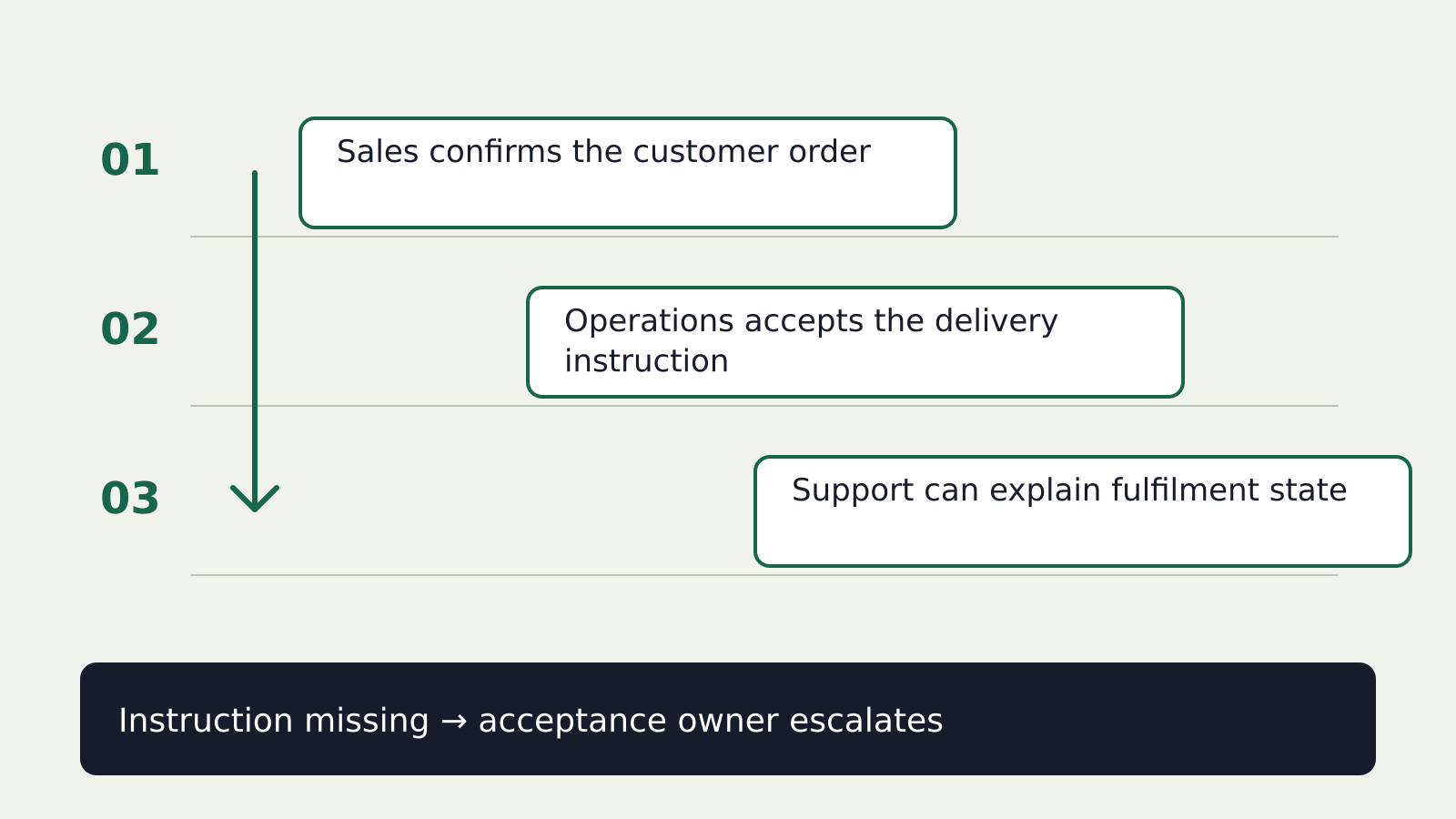
- Sales confirms the customer order
- Operations accepts the delivery instruction
- Support can explain fulfilment state
- Instruction missing → acceptance owner escalates
Draw responsibility and evidence
For each handoff, record the sending role, receiving role, information required, system of record and acknowledgement. “Sales sent an email” is not the same as “warehouse accepted a fulfilment instruction.” If a task can sit in a queue without an owner, draw that wait state. If staff use a spreadsheet or private chat to repair missing data, show it. The workaround is part of the real process.
Do not confuse a map with proof. One case can expose a failure mode but cannot establish how often it occurs. Compare several recent orders, including successful ones, and measure the waiting time where possible. Ask support what customers report and whether those complaints match system events.
Use the map to decide what to change
Suppose the delay comes from a missing stock confirmation. A new tracking page may make the uncertainty visible but cannot resolve it. The first change could be a named stock owner, an acknowledgement rule and an escalation when no confirmation arrives. Then the team can decide whether software should automate the notification or connect the systems.
A map should let the founder ask a concrete question: which transfer causes the most customer harm, what would improve it, and who can approve that change? Mark the evidence behind the answer. If the process spans external partners, include the boundary and what the business can actually control.
Keep it small enough to use
The first map does not need every department and product. One customer promise, one representative journey and one exception are enough to reveal a decision. Revise it as more cases are observed. Assign an owner to the proposed change and a measure that would show whether the order moves more reliably.
Compare the next moves
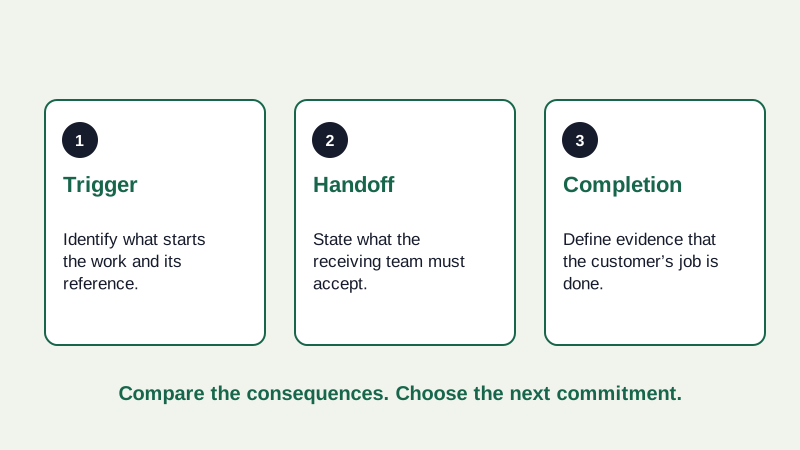
- Trigger: Identify what starts the work and its reference.
- Handoff: State what the receiving team must accept.
- Completion: Define evidence that the customer’s job is done.
A working-session prompt
- What starts and completes the customer’s task?
- Where does information cross a person, team or system boundary?
- What evidence must travel, and how is receipt acknowledged?
- Where can the case wait without a named owner?
- What does the customer hear when the normal route fails?
Research note: the UK Government Service Manual on mapping a whole problem recommends examining the user journey alongside backend processes, evidence and the people involved. This article applies that method to a fictional distributor; it does not report measured client results.
Sources & scope
Related primary reading is provided below. The decision framework and fictional examples are Parikh Advisory’s analysis; these references do not establish that the illustrated events occurred.
- Understand users and their needsUK Government Digital Service