
The business situations in this article are fictional illustrations, not accounts of Parikh Advisory client engagements.
A SaaS founder interviews a product manager, a consultant and a fractional product executive. All three can ask good questions. The job description says only “help us with product.” Until the founder names the decisions and work that need an owner, each candidate is interviewing for a different job.
Illustrative scenario. These titles do not have universal definitions. A consultant may work closely with a team for months; a product manager may lead a whole portfolio; a fractional executive may advise without formal authority. The engagement agreement and daily operating reality matter more than the label.
Decide whether you need an answer, a cadence or leadership
Start with the concrete gap. Is there one consequential question—such as why onboarding fails—that needs an independent investigation? Is a team missing someone to continuously discover needs, prioritize and coordinate delivery? Or do multiple teams need leadership on investment choices, product direction and capability? A bounded answer, continuous product work and leadership ownership have different time horizons and dependencies.
A consultant can be effective for a defined diagnosis or decision. A product manager can own an ongoing area of product work with access to customers and the delivery team. A fractional product leader can take an agreed portion of executive leadership for limited capacity. A full-time leader may be necessary when decisions, people management and availability cannot fit a fractional mandate.
Follow the situation
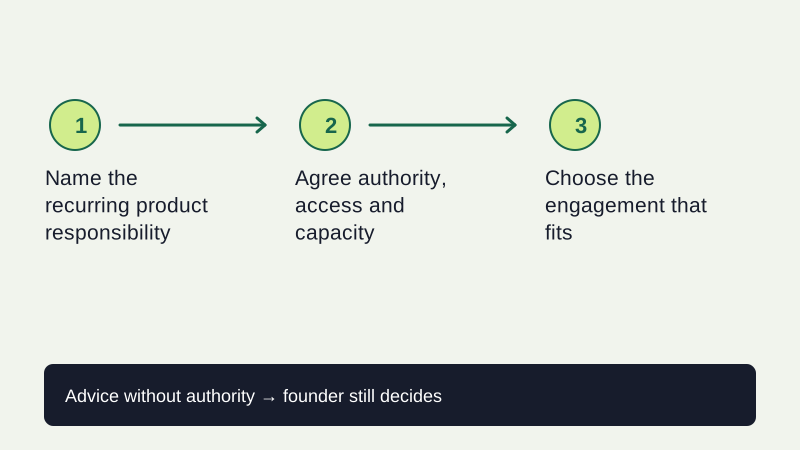
- Name the recurring product responsibility
- Agree authority, access and capacity
- Choose the engagement that fits
- Advice without authority → founder still decides
Write the mandate as decisions
For the founder’s next quarter, list the decisions that need making: which customer segment to serve, which evidence would justify a roadmap change, who can approve trade-offs, how product and sales resolve conflicting commitments, and who develops the team’s product judgment. Mark each as one-time, recurring or daily. Then identify the authority and information required. This reveals whether the organization needs a project, a role or a leadership partnership.
A fractional leader may attend a weekly decision forum and work directly with the founder, but cannot be treated as an always-on escalation point unless that capacity is contracted. A PM may run discovery and delivery, but cannot decide a company-level pricing or market pivot without a mandate. A consultant’s recommendations need an internal owner to implement them. Name these limits before signing.
What each option asks of the organization
- Focused consultant: Supply a clear question, access to evidence and an internal decision owner. Expect a bounded output and agreed follow-through, not indefinite accountability.
- Product manager: Provide a defined product area, cross-functional partners, decision rights and a leader who can resolve company-level trade-offs.
- Fractional product leader: Agree capacity, executive access, authority, cadence, team support and what happens between engagements. Decide whether the person advises, decides or manages.
- Full-time product leader: Provide sustained scope, budget and the willingness to transfer real responsibility. A title without authority will not solve the founder bottleneck.
The right choice may be no external hire yet. If the founder has not decided what the business is trying to achieve, an expensive role can merely organize uncertainty. A short diagnostic or a sharper internal decision rhythm may be the better first move.
A practical selection test
Give each candidate the same recent decision, with the facts and uncertainties you actually have. Ask what they would do in the first month, what access they need, which decision they would own, and what they would deliberately leave with the founder. Ask how they would tell whether their intervention helped. Compare the proposed operating model rather than charisma or a familiar title.
Document the interface with the team: meeting rhythm, escalation, written decision record, customer access and handoff at the end. If a fractional arrangement ends, who retains context? If a consultant identifies a gap, who acts? If a PM joins, who coaches and evaluates them? These questions determine whether the role can produce a result.
Compare the next moves
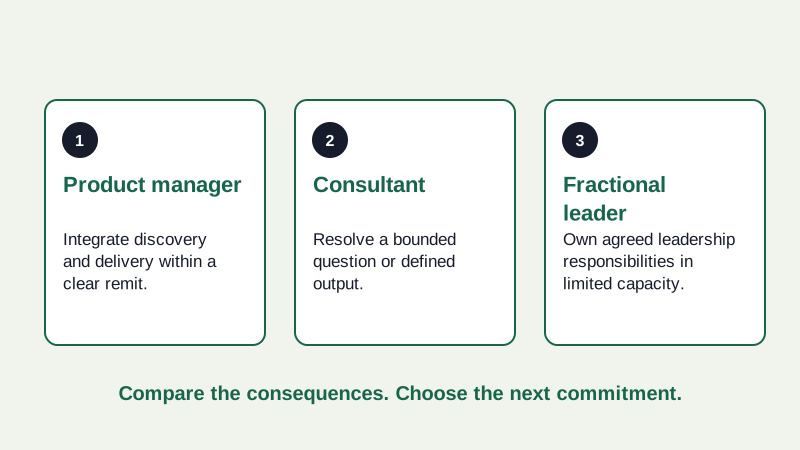
- Product manager: Integrate discovery and delivery within a clear remit.
- Consultant: Resolve a bounded question or defined output.
- Fractional leader: Own agreed leadership responsibilities in limited capacity.
A choice you can defend
Choose the smallest commitment that gives the actual decisions a capable owner. If the gap is bounded, commission a bounded answer. If product work is continuous, staff it. If leadership trade-offs recur but full-time capacity is not justified, test a clearly scoped fractional mandate. If daily leadership and people management are required, hire accordingly. Revisit the choice when the decision load changes.
Research note: Silicon Valley Product Group’s discussion of product managers and leaders shows why responsibilities differ across individual and leadership roles. The UK Government product-manager capability framework illustrates how scope can range from one product area to a portfolio. Neither source standardizes the commercial terms “consultant” or “fractional CPO”; those must be defined in the specific engagement.
Sources & scope
Related primary reading is provided below. The decision framework and fictional examples are Parikh Advisory’s analysis; these references do not establish that the illustrated events occurred.
- Understand users and their needsUK Government Digital Service