
The business situations in this article are fictional illustrations, not accounts of Parikh Advisory client engagements.
Sales wants a faster quote. Operations wants fewer fulfilment exceptions. Finance wants tighter payment controls. Each department sees a real cost, but a company cannot commit the same people to three incompatible top priorities. Alignment begins when leaders compare the effects of a decision on the whole customer journey and agree who will own the trade-off.
Define the shared decision
Agree on a horizon, such as the next quarter, and the business result under discussion. Is the constraint lost conversion, delayed cash, avoidable rework, or a compliance exposure? Ask each function to describe a concrete occurrence with volume, severity and consequence. This avoids a debate where every team presents its preferred solution while using a different definition of success.
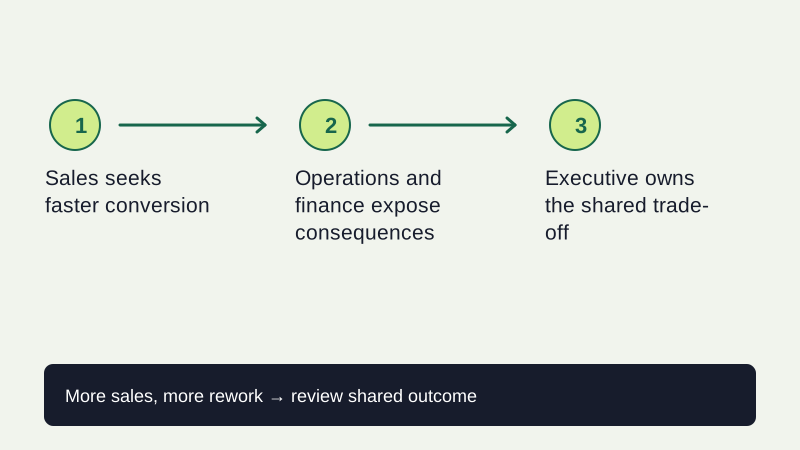
Follow the situation
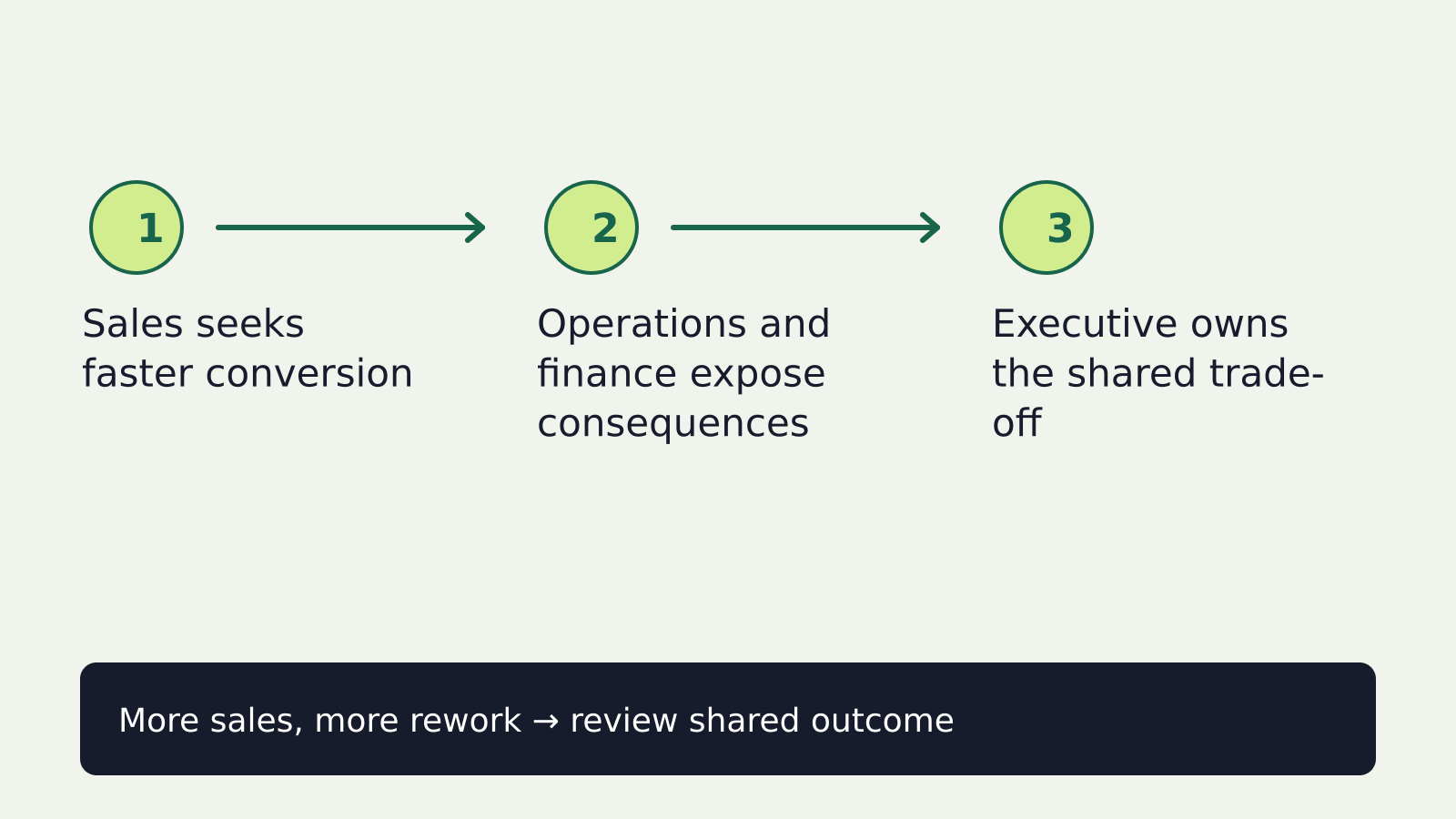
- Sales seeks faster conversion
- Operations and finance expose consequences
- Executive owns the shared trade-off
- More sales, more rework → review shared outcome
Trace the dependency
A faster quote may increase orders that operations cannot reliably fulfil. An extra finance check may reduce errors while lengthening sales response time. Map the customer promise from enquiry through delivery and payment; show where each proposed change creates or relieves work for another team. Invite the person who operates the handoff, not only the department head. Their exception cases often reveal the real constraint.
Choose the constraint to relieve
Separate urgent controls from optional growth investments. If an unowned refund exception creates material risk, assign an immediate containment action. Then compare the remaining investments by expected effect, evidence, capacity and reversibility. The executive sponsor should make the final decision and document whose cost is being accepted. Consensus on every detail is unnecessary; clarity on the rationale is essential.
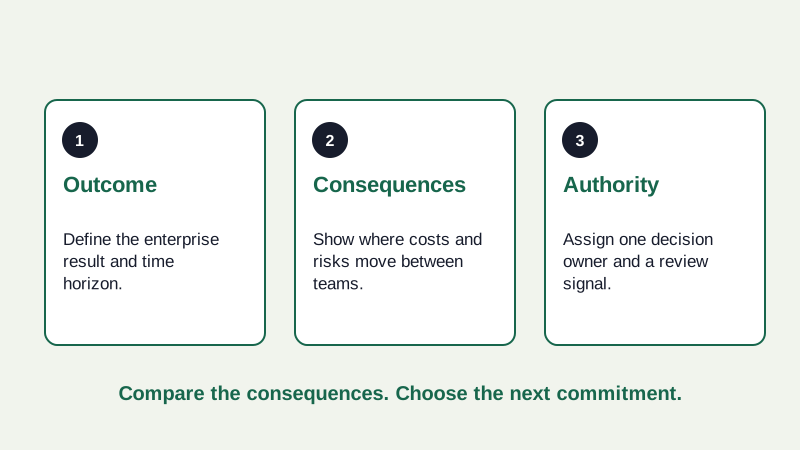
Compare the next moves
- Outcome: Define the enterprise result and time horizon.
- Consequences: Show where costs and risks move between teams.
- Authority: Assign one decision owner and a review signal.
Create one operating cadence
Maintain a decision log with owner, metric, dependencies and date for review. Let functions raise new evidence through the same forum instead of maintaining private priority lists. If the quote change goes ahead, monitor fulfilment exceptions as well as conversion. A single top-line metric can reward one team while shifting the problem elsewhere. The cadence matters more than another alignment workshop.
A decision to take into the next meeting
Bring one actual case, name its owner and decide what evidence would justify the next investment. If the evidence is missing, make the smallest useful test the next action. Record the choice and the date to review it.
Source note: GOV.UK Service Manual, governance principles for agile service delivery. The example is illustrative; the source informs the method or control discussed, not the imagined business.
Sources & scope
Related primary reading is provided below. The decision framework and fictional examples are Parikh Advisory’s analysis; these references do not establish that the illustrated events occurred.
- Understand users and their needsUK Government Digital Service