
The business situations in this article are fictional illustrations, not accounts of Parikh Advisory client engagements.
Sixty hours a month is about fifteen hours a week on average, before any surge in meetings or incident work. It can be meaningful leadership time, but only if the company gives the fractional product leader a defined mandate and access to decisions. Treating the arrangement as a substitute for an entire full-time department will exhaust the hours before it changes the product.
Buy a decision remit, not a task menu
A workable mandate might be to own the next-quarter product direction for one product line: clarify goals, review discovery evidence, make roadmap trade-offs with the founder, and guide a delivery lead. State which decisions can be made independently and which require founder approval. Without authority, the leader becomes an expensive note-taker in recurring meetings.
Follow the situation
- Agree the leadership decisions to own
- Reserve time for team and customer work
- Reprioritize explicitly when needs change
- Urgent work arrives → agree what moves
Budget the month honestly
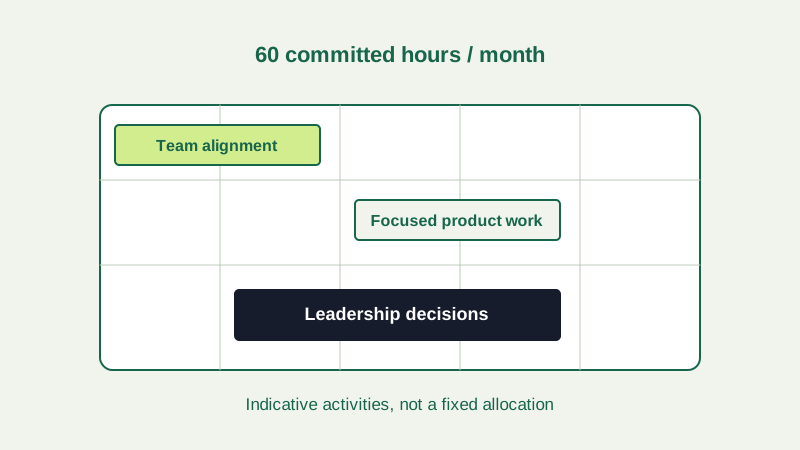
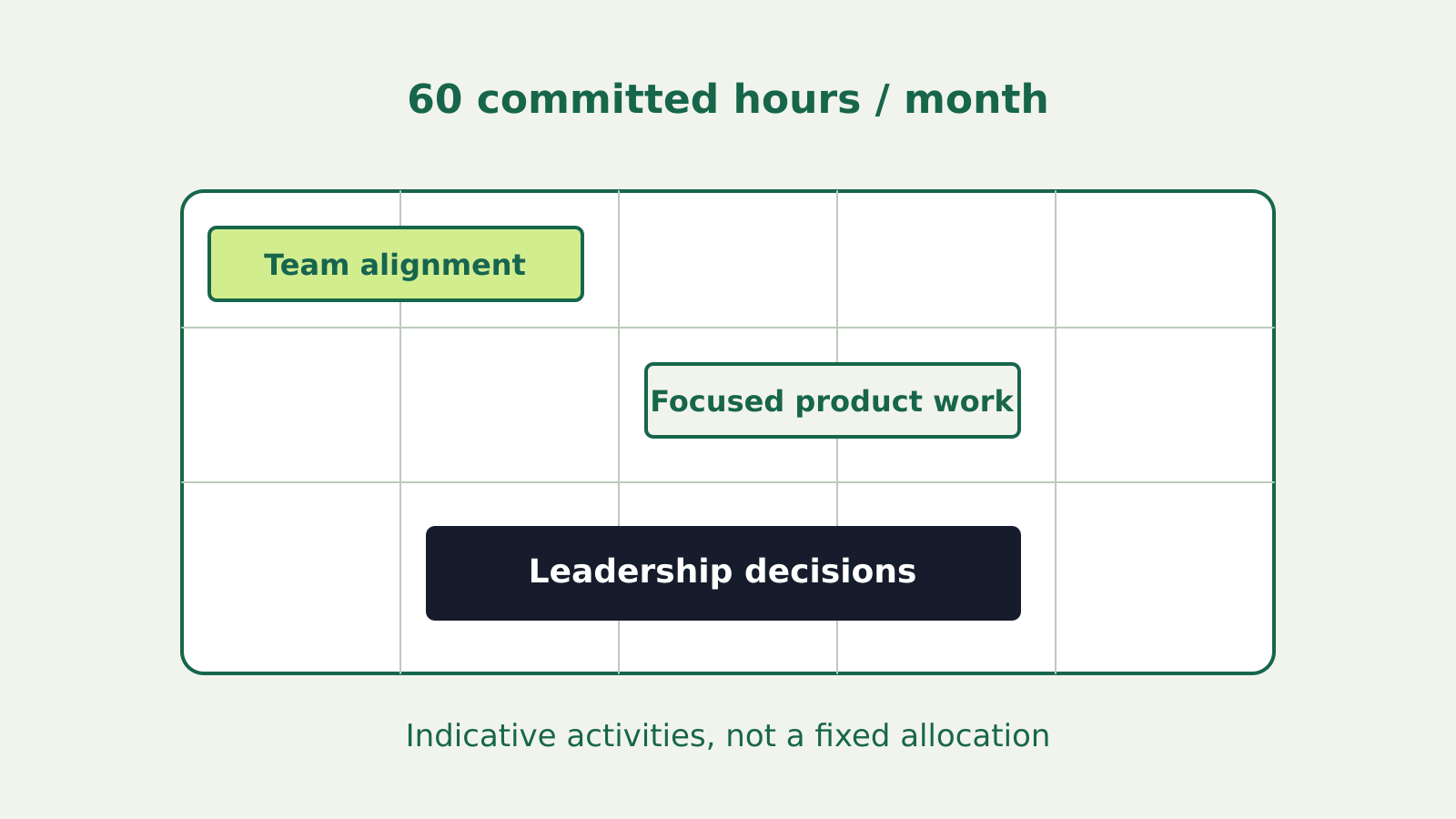
An illustrative allocation could be 12 hours on customer and performance evidence, 16 on roadmap and trade-offs, 16 on team guidance and delivery decisions, 8 on stakeholder alignment and 8 on documentation and review. It is a planning example, not a promised package. A launch, major incident or travel-heavy month changes the mix. Agree what falls away when new urgent work arrives.
Name the internal counterpart
The business still needs an available founder or executive sponsor and operational people who can carry decisions through. A fractional leader can coach a PM, challenge briefs and unblock cross-functional choices. They cannot be simultaneously the daily product manager for several squads, the design lead, compliance owner and on-call responder within the same 60 hours.
Compare the next moves
- Mandate: Specify decisions, access and team responsibilities.
- Capacity: Balance recurring commitments with focused product work.
- Change: Trade off new requests within the agreed hours.

Review outcomes after one cycle
Use a short monthly review: decisions made, assumptions tested, bottlenecks removed, commitments missed and next month’s allocation. Judge the relationship by improved decision quality and delivery clarity, not the volume of meetings. If the organization needs daily presence, line management and constant escalation, a full-time hire may be the more honest answer. At $75 per hour, 60 hours is $4,500 before any separately agreed costs; confirm the current agreement and scope.
The next decision
Put the mandate and first month’s hour allocation beside the founder’s actual decision rights, then remove work that cannot fit.
Source note: GOV.UK Digital and Data profession, product manager role. The scenario and proposed allocation, where applicable, are illustrative; the linked source supports the underlying method or regulatory context.
Sources & scope
Related primary reading is provided below. The decision framework and fictional examples are Parikh Advisory’s analysis; these references do not establish that the illustrated events occurred.
- Understand users and their needsUK Government Digital Service