The business situations in this article are fictional illustrations, not accounts of Parikh Advisory client engagements.
A CEO asks for a UX audit because customers abandon an application form. A researcher observes that the form is hard to understand. A product lead notices that applicants are asked for documents they do not yet have. Both findings could be true. A clearer interface may reduce confusion while leaving the underlying eligibility and evidence policy untouched.
Illustrative scenario. The decision is not which audit sounds broader. It is which question needs an answer, what evidence the reviewer can access and who has authority to act on the findings. “UX audit” and “product audit” are service labels, not protected methods with identical scope across providers.
Scope the question before choosing the reviewer
If applicants know what information they have but cannot find the right control, understand the wording or recover from an error, usability research is a direct way to investigate. A reviewer can observe representative people attempting the task, examine accessibility and content, and identify interaction problems. An expert review can raise hypotheses quickly; observing actual users tests whether those hypotheses explain the friction.
If applicants cannot satisfy the requested information, the question reaches beyond interface design. Why is it required at this stage? Who set the rule? Could evidence be collected later or through a different channel? What does the business need to decide, and what risks would a change create? A broader product assessment may need operations, policy, technical and commercial evidence as well as user research.
The two scopes overlap. A capable UX team may examine the end-to-end service and challenge a business rule. A product audit may include usability testing. Ask for a method and deliverable, not a title alone.
Follow the situation
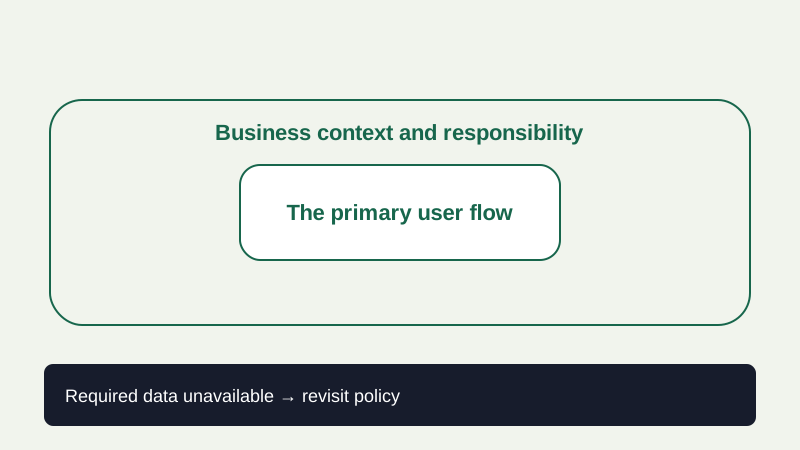
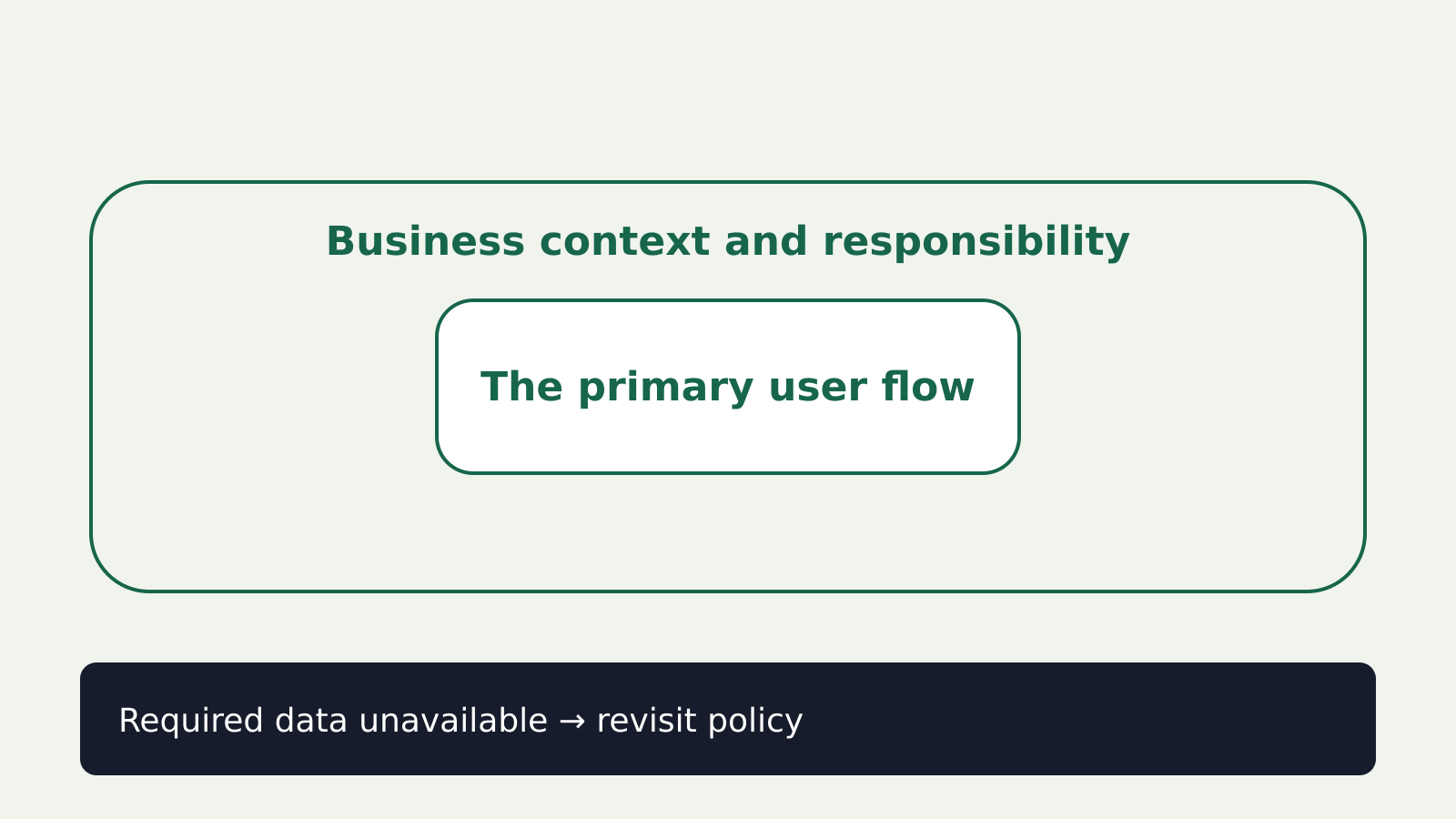
- User encounters a confusing form
- Team checks the information requirement
- Choose research that can answer why
- Required data unavailable → revisit policy
Follow one abandoned case
Take a recent application and reconstruct the journey. What did the applicant try to do? Which field caused trouble? Was the document available? What did the error say? Did support intervene? Was there an alternative route? Look at completed cases too: a low completion rate may come from a specific customer segment, a device or a policy state rather than the whole experience.
Separate observations from explanations. “Three participants could not understand this label” is an observation from those sessions. “The label causes the majority of abandonment” is a broader causal claim requiring more evidence. “Removing the document request will improve approval quality” is an untested business hypothesis. This distinction makes the audit more useful to the person who must approve a change.
What a useful audit should leave behind
- For a focused usability question: representative tasks, observed friction, severity and accessibility considerations, with proposed design changes and a way to test them.
- For a broader product decision: the customer job, funnel and operating evidence, business rule and ownership, competing explanations, options and a recommended sequence.
- For either: a clear scope, data limitations, decision owner and separation of quick fixes from questions requiring further investigation.
A short audit cannot prove market demand, certify compliance, redesign an entire platform or guarantee improved conversion. If the review has one primary flow, name it. If a security or regulatory issue emerges, route it to qualified specialists rather than stretching the audit label to cover it.
When to combine the disciplines
In the application example, first observe users attempting the form and examine abandonment by relevant segment. At the same time, have the policy owner explain why the document is requested at that moment and what would happen if its timing changed. Then test a smaller change: clearer wording, a save-and-return route, or revised evidence timing if policy permits. The order depends on which uncertainty is most consequential and easiest to resolve.
A design improvement may be the right first move even when the larger product question remains open. Conversely, a perfect form can be the wrong investment if the required document is unavailable to the intended customer. The audit should make that trade-off explicit.
Compare the next moves
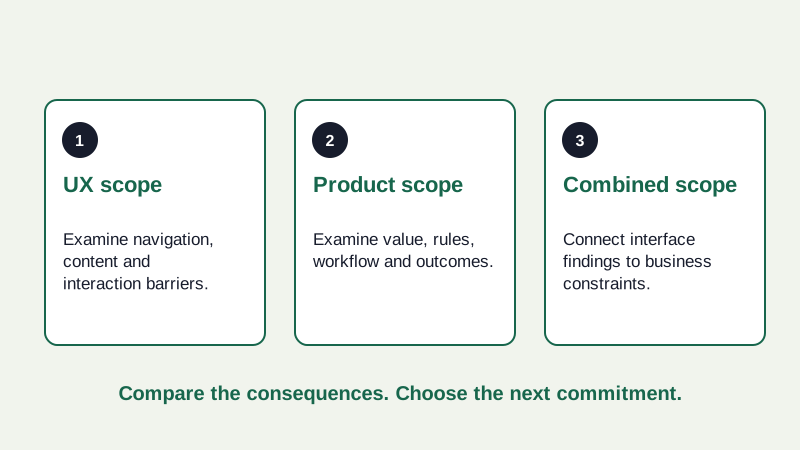
- UX scope: Examine navigation, content and interaction barriers.
- Product scope: Examine value, rules, workflow and outcomes.
- Combined scope: Connect interface findings to business constraints.
A commissioning brief
- What decision must this review inform?
- Which customer journey, segment and outcome are in scope?
- What evidence can the reviewer inspect, including failed cases and user access?
- Who owns the underlying business rules and can approve a change?
- Which findings need a specialist review or a separate experiment?
Method reference: Nielsen Norman Group’s usability testing guidance describes observing people perform realistic tasks. The UK Government Service Manual’s discovery guidance emphasizes understanding users, constraints and the wider journey before committing to a solution. These sources inform the method, not the scope of any particular Parikh Advisory engagement.
Sources & scope
Related primary reading is provided below. The decision framework and fictional examples are Parikh Advisory’s analysis; these references do not establish that the illustrated events occurred.
- Understand users and their needsUK Government Digital Service