The business situations in this article are fictional illustrations, not accounts of Parikh Advisory client engagements.
“Every company with a sales team” is a market description, not a useful first customer segment. Early product and go-to-market work needs a group whose problem, buying trigger and route to purchase are similar enough that one offer can be tested repeatedly. Focus is a learning choice; it does not permanently exclude other customers.
Define a segment by a buying situation
Start with a specific organization, role and trigger: for example, a mid-sized lender expanding to a second loan product whose operations lead needs consistent exception handling. Industry alone is too broad. Identify the person living with the problem, the economic buyer, approvers, budget source and deadline. A user who loves a prototype may have no path to buy it.
Follow the situation
- Name a buyer with a specific urgent job
- Check authority, access and existing alternatives
- Choose a narrow learning opportunity
- Interest without purchase path → revisit segment
Compare two or three candidates
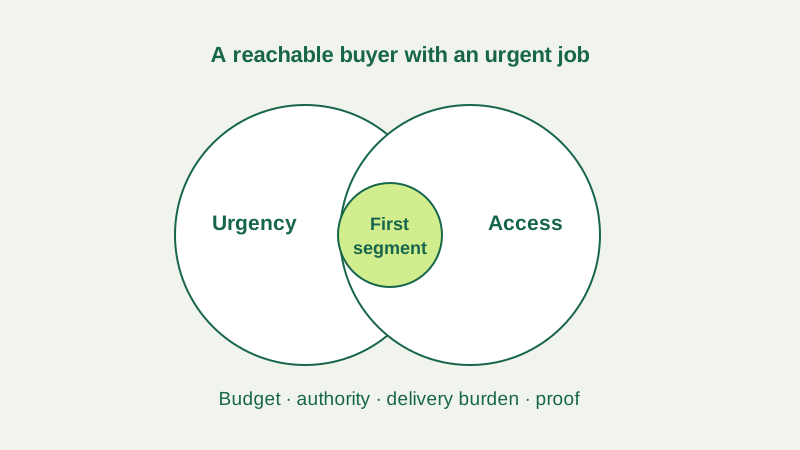
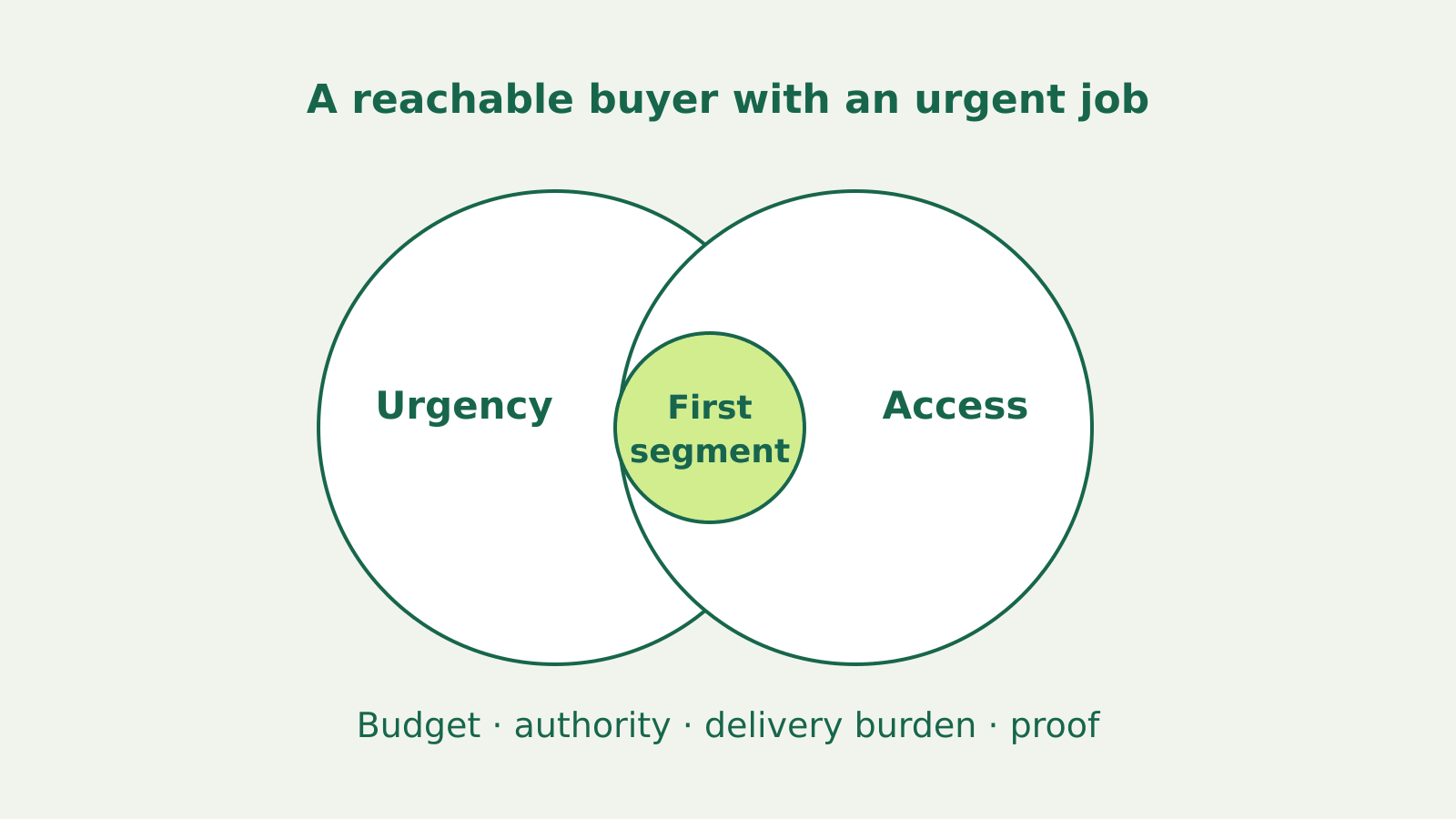
For each candidate, examine urgency, cost of the current workaround, ability to reach buyers, willingness and ability to pay, implementation burden, reference potential and fit with your capabilities. Use conversations and observed behavior, not a spreadsheet of invented market-share decimals. Note where the founder’s network gives access and where it creates a biased sample.
Test the promise in the market
Interview people about a recent occurrence, current alternatives and what happened when they tried to solve it. Then make a concrete offer with scope and price and see whether a buyer takes a meaningful next step. Compliments and survey interest are weaker than a paid pilot or a procurement conversation with an owner. Record objections; a repeated objection may point to the wrong segment, offer or proof.
Compare the next moves
- Urgency: Identify a real trigger and cost of the problem.
- Access: Check whether you can reach the actual decision maker.
- Repeatability: Test delivery burden and shared needs across buyers.

Commit to a learning period
Choose one primary segment for the next cycle, define the message and acquisition route, and set a review date. Track qualified conversations, conversion through stages, delivery cost and early value. If evidence fails, narrow or change the segment. If one unusual large client asks for bespoke features, decide whether that work builds a repeatable proposition or funds a deliberate exception.
The next decision
Compare two real buying situations and run a concrete offer test with the more reachable candidate.
Source note: Strategyzer, Value Proposition Canvas. Examples are illustrative; the linked source supports the decision method, not the hypothetical business.
Sources & scope
Related primary reading is provided below. The decision framework and fictional examples are Parikh Advisory’s analysis; these references do not establish that the illustrated events occurred.
- Understand users and their needsUK Government Digital Service