
The business situations in this article are fictional illustrations, not accounts of Parikh Advisory client engagements.
At 9:17 on a Monday morning, a merchant’s finance manager opens the payments dashboard. One order is marked Successful. The customer’s account shows a debit. The merchant, however, cannot find the amount in the expected settlement file.
Customer support calls it a payment problem. Engineering says its API returned success. The payment processor asks for a reference number. Finance says the books cannot close until someone explains the missing line.
Everybody has a plausible answer. Nobody can say, with confidence, what happened to the money.
This is an invented but realistic illustration. Its value isn’t the drama of a lost transaction; the payment may simply be awaiting settlement. The larger issue is that “successful” can mean different things to different systems, at different moments, for different purposes.
For a growing FinTech company, payment reconciliation is not a back-office clean-up exercise. It is a product, data, control and operating-model decision. Customers want to know what happened. Finance needs defensible balances. Risk needs an audit trail. Engineering needs reliable event handling. The CEO needs to know whether exceptions are visible before they become surprises.
The first mistake is treating one status as the whole truth
In our scenario, the customer paid for a service. A checkout interface returned confirmation. An acquiring processor recorded a transaction. A settlement process would later produce amounts, adjustments and perhaps fees. The merchant’s bank account would reflect a deposit on its own schedule. Refunds and disputes could create further movements.
Those are related events, not one event.
A system can truthfully say an authorization succeeded without proving funds have settled. A processor may report a payment as captured while the merchant expects the net settlement after fees and adjustments. An order may be fulfilled while a reconciliation item remains unresolved. A bank deposit might aggregate many transactions into one line. A reversal can arrive after the original event.
The product danger is not that asynchronous systems exist. It is using one field—payment_status=success—to stand in for all those business states.
This distinction is central to mature payments operations. AWS’s publicly documented payment architecture guidance emphasizes persistent transaction records and idempotent processing, including the handling of events that may arrive more than once. Its architecture examples show separate activities for initiation, processing, tracking and settlement. These sources describe architectural approaches, not the design or performance of our hypothetical merchant. [1] [2]
Follow the situation
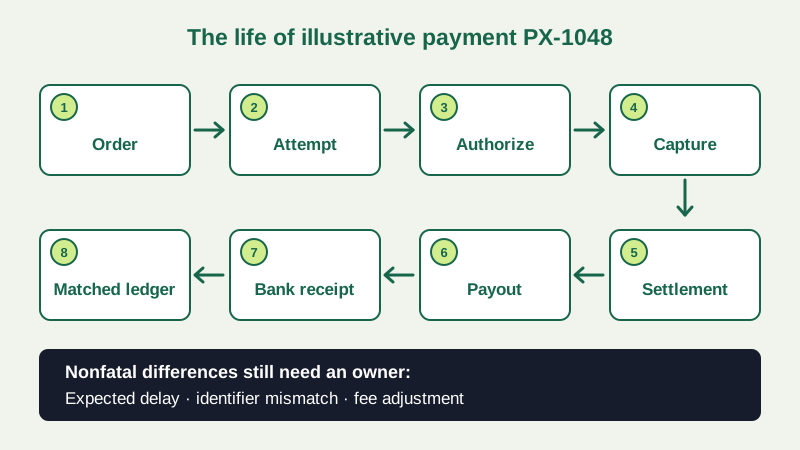
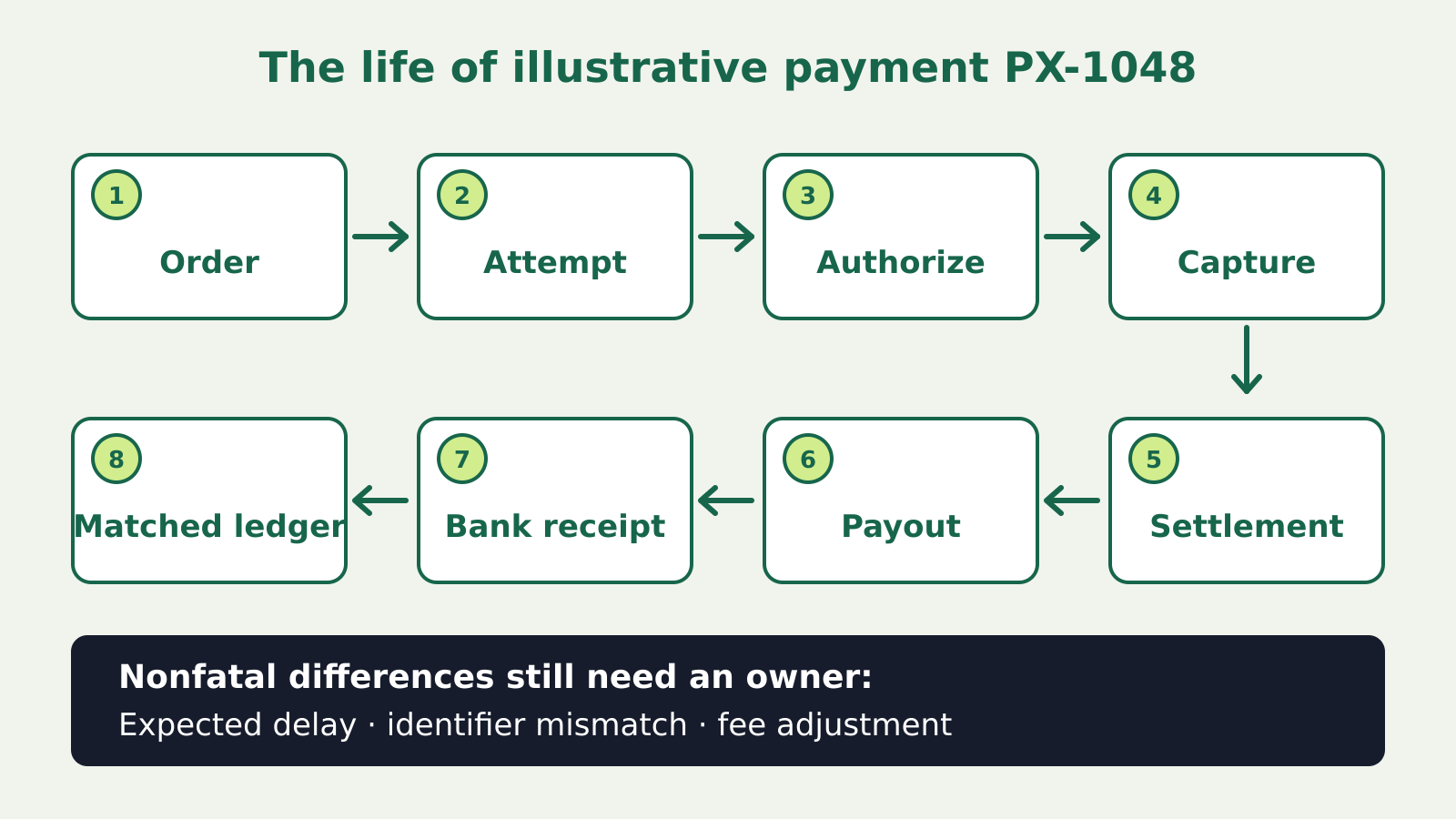
- Order PX-1048
- Payment attempt
- Authorization
- Capture
- Settlement batch
- Payout
- Bank receipt
- Matched ledger line
- Exception: expected delay → confirm the settlement window
- Exception: provider ID mismatch → investigate the link
- Exception: fee difference → reconcile the adjustment
Follow the payment, not the teams’ org chart
Imagine the finance manager searches for transaction PX-1048.
The checkout service knows the merchant order ID. The orchestration system knows a provider-specific reference. The settlement file contains another identifier. The payout groups hundreds of transactions. The bank feed knows only the payout amount and bank reference.
Each team can retrieve a piece, but the company cannot join the pieces without manual interpretation.
That is often where the product problem begins. The system captured enough information to process the transaction, but not enough shared meaning to answer questions afterward.
The smallest useful reconciliation map includes:
The initiating business event. What was the customer paying for? Which order, account and merchant entity owns that obligation?
The payment attempt. How many attempts occurred? Which provider and route were used? Did a retry create a second attempt or did it safely reuse a request identifier?
Authorization and capture. What did the provider actually confirm, and at what time?
Settlement and adjustment. What gross amount, fees, taxes, FX differences, refunds or chargebacks were recorded, in which currencies and periods?
Payout and bank receipt. Which payout aggregated the movements? What evidence connects the payout to the bank movement?
Reconciliation decision. Did the expected and observed amounts match within defined rules? If not, who investigates and by when?
A founder doesn’t need to personally code this chain. But someone must own its meaning across product, finance, risk and engineering.
A missed match is not automatically missing money
Return to the merchant. The payment was successful at checkout, but nothing appears in today’s settlement report. There are several plausible explanations.
Perhaps the provider’s settlement cycle hasn’t completed. Perhaps a transaction is included in tomorrow’s file because of a cut-off time or holiday. Maybe fees mean the bank deposit will not equal the gross sales total. It might be a separate merchant account, a late-arriving event, a currency conversion or an incomplete link between identifiers. In more serious cases, a duplicate, reversal or processing failure could require immediate investigation.
The crucial design decision is to avoid putting all of these explanations into a generic queue labelled “payment failed.”
A sensible exception system distinguishes timing difference, identifier mismatch, amount difference, duplicate event, unexpected reversal, missing provider record and unexplained bank movement. Each has different evidence requirements, owner and escalation rules. A bank-credit mismatch shouldn’t be treated like a delayed webhook.
The product team should agree on which differences can remain open until an expected settlement window and which must trigger investigation immediately. Those thresholds will vary by business, rail, jurisdiction, customer contract and risk appetite. There is no responsible universal timer I can offer here.
When the company reaches more than one provider
Now imagine the FinTech business expands. It adds a second processor to improve reliability. Then it adds a payout partner in another market. One provider reports a captured payment as settled; another uses a separate payout status. One sends refunds as negative transactions; another reports them in adjustments. Time zones, cut-offs and fee models differ.
The obvious response is to build more dashboard filters.
The harder question is whether the company has a canonical transaction model that describes economic events independently of each provider’s terminology. Without it, every new integration adds another set of assumptions to finance operations.
A good canonical model need not erase provider detail. It should retain raw external records for auditability while mapping them to agreed internal meanings. That includes transaction lineage, currency, amount precision, timestamps, provider identifiers, event version, status transitions and reconciliation references.
Do not build the model only for the happy path. Ask what happens when an event arrives late, is delivered twice, is corrected, is replayed after an outage, or conflicts with a previous state. A robust event consumer must distinguish a duplicate message from a new economic obligation. AWS’s transactional outbox guidance discusses duplicate delivery and recommends idempotent consumers that track processed messages. [3]
The meeting a Series B founder should convene
At this point, another sprint focused solely on UI may not solve the problem. The founder should bring together the owners of product, finance, engineering, operations and risk. The objective isn’t to debate whose fault the mismatch was. It is to answer six questions.
What is the source of truth for each stage? “Payments database” is not sufficient. Authorization, capture, settlement, payout and bank receipt may have different authoritative sources.
What is our exception taxonomy? Can a finance analyst identify why an item is unresolved, or is everything manually investigated from scratch?
Who owns the exception queue? Engineering should repair broken integrations, but finance or payments operations may own reconciliation decisions. Risk and compliance may need separate escalation paths.
What does the company owe the customer? A merchant-facing dashboard needs precise language. “Payment accepted” is not identical to “Funds available.” Each term should match a defined state.
What evidence survives an incident? Preserve immutable or appropriately governed logs, original provider payloads where permitted, event versions and operator decisions. Access and retention rules depend on law and contracts.
What do we measure? Useful indicators include unresolved items by age and category, value at risk, manual investigation time, repeated exceptions by provider, and correction rates. Raw unmatched count alone can be misleading if volume doubles.
A CEO who asks only “Are reconciliations green?” receives a colour. A CEO who asks these questions learns whether the operating control is dependable.
Three product investments—and the order matters
There is no single architecture everyone should buy. The decision depends on volume, current financial controls, payment partners, legacy constraints and regulatory obligations. Still, investment choices often fall into three broad areas.
First: explainability. Make each transaction traceable through shared identifiers, mapped statuses and source evidence. This may be more urgent than a sophisticated automated matcher. If people cannot explain a mismatch, automation may simply hide it faster.
Second: disciplined exception operations. Classify differences and route them to responsible owners with investigation and resolution history. Establish review intervals and escalation thresholds. Make decisions visible, not dependent on someone’s inbox.
Third: automation. Add matching rules, tolerances, retry handling, file ingestion, alerts and controls where patterns are understood. Automation should reduce repetitive work without silently resolving exceptions that need judgment.
A startup processing a modest volume through one partner may meet its control needs using configured tools and documented processes. A multi-market platform with numerous payment routes, complex settlements and risk exposures may justify a dedicated reconciliation service. The goal is to earn the complexity rather than declare it sophisticated.
A public architecture example—and its limits
AWS has published a payment-system architecture guidance that explicitly addresses persisting and idempotently processing transactions. AWS has also described an event-driven payment-orchestration pattern in which initiation, execution, tracking and settlement use specialized components with correlation identifiers for traceability. [1] [2]
That is useful because it makes a principle visible: a single real-world payment produces several events that must remain linkable. It does not prove that AWS operates our imaginary merchant’s systems, that adopting its architecture produces a particular return on investment, or that every FinTech needs microservices. For some organizations, a well-controlled modular system and careful process ownership are safer than premature distribution.
The design test is not whether the architecture looks modern. It is whether finance can explain a balance, the customer can understand a status, and the organization can resolve an exception without guessing.
Compare the next moves
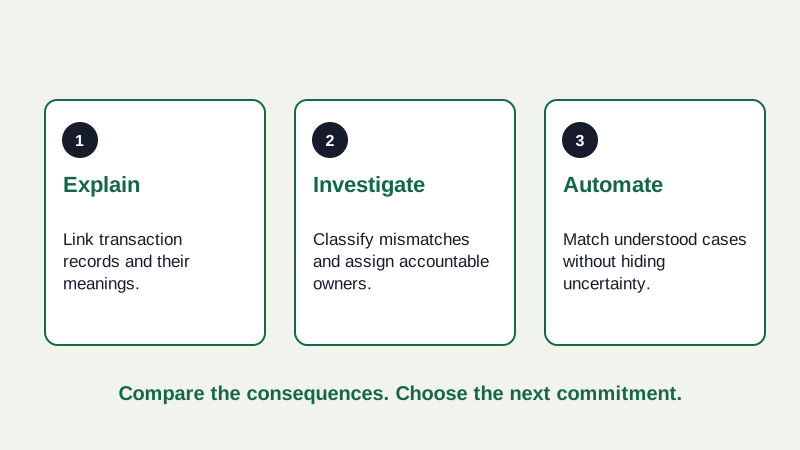
- Explain: Link transaction records and their meanings.
- Investigate: Classify mismatches and assign accountable owners.
- Automate: Match understood cases without hiding uncertainty.
Back to Monday morning
Imagine that the finance manager now opens PX-1048 and sees the story of the money: the order, the payment attempt, the confirmed capture, the expected settlement batch, the payout and the bank movement. The screen identifies an expected delay; it shows when to check again and who owns the exception if the deadline passes.
No one had to pretend the payment was fully settled before it was. And no engineer had to become the permanent interpreter between finance and the processor.
The invisible product has become understandable.
If you’re leading a growing FinTech business, ask to trace one transaction that did not reconcile immediately. Follow every record, identifier, person and decision involved. That exercise often tells you more about the maturity of your payment operating model than another feature demonstration.
Parikh Advisory’s principle is simple: before funding a reconciliation rebuild, know what the organization means by a transaction, a settlement and an exception. Then choose the smallest dependable change that makes the chain explainable and controlled.
Sources & scope
Numbered references support the attributed guidance in this article.
- Building Payment Systems Using Event-Driven ArchitectureAWS
- Modernization of Real-Time Payment OrchestrationAWS / IBM architecture example
- Transactional outbox patternAWS
Educational product and operating analysis. Applicable legal, financial, risk and compliance requirements need qualified review for the specific activity and jurisdiction. This article does not certify launch readiness or compliance.