
The business situations in this article are fictional illustrations, not accounts of Parikh Advisory client engagements.
A borrower sees “approved” and expects the funds. The lender’s origination team has completed its decision, but disbursement conditions remain unchecked and the servicing team has not accepted the account. From the borrower’s perspective, there is only one loan journey. Inside the organization, a weak handoff can turn an accurate approval message into a misleading promise.
Illustrative scenario. Loan origination software and loan management or servicing software often serve different stages, but vendors draw their boundaries differently. The important design question is which system owns each state, term and customer communication from application through closure.
Approval is not the whole loan
Origination commonly covers application intake, evidence, assessment, decision and offer. Servicing commonly covers the live account: balances, repayment schedule, payments, amendments, arrears, communications and closure. Disbursement can sit at the boundary or within one system, depending on the institution and product. Do not assume a product name defines the handoff.
Write the borrower-facing states first. Has the application been received, conditionally approved, finally approved, accepted, ready for disbursement, disbursed or active? What may still prevent the next step? The message “approved” should not imply funds are on the way if material conditions remain. The policy and legal meaning of each state need the responsible lender’s review.
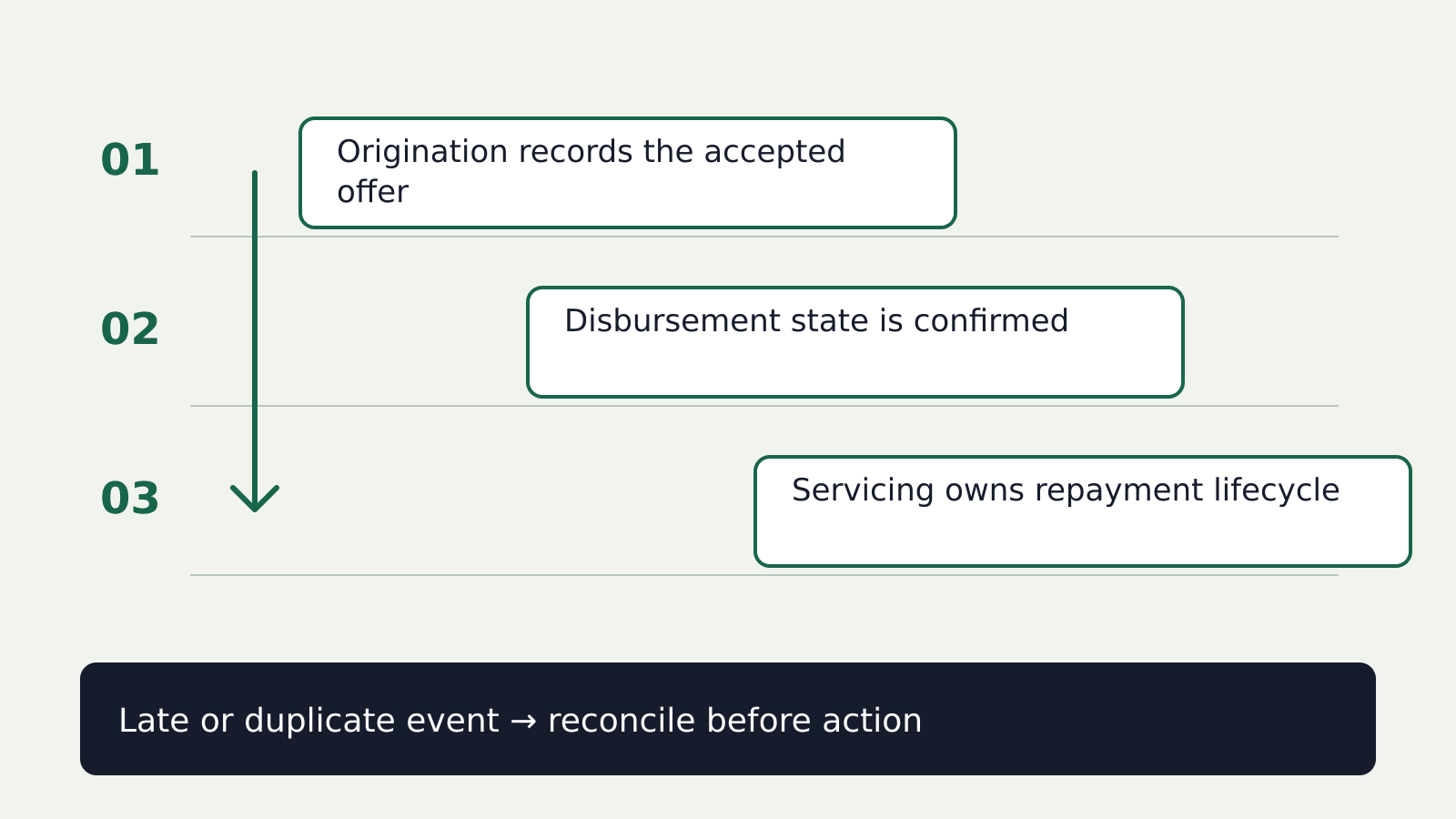
Follow the situation
- Origination records the accepted offer
- Disbursement state is confirmed
- Servicing owns repayment lifecycle
- Late or duplicate event → reconcile before action

Define what servicing must inherit
A servicing system cannot safely reconstruct the agreement from a status flag. It may need the executed terms, principal, rate or pricing basis, repayment calendar, fees, borrower and account identifiers, disbursement record, collateral or guarantees where relevant, consent and communication history, and any conditions or exceptions that remain open. The exact data depends on the loan and jurisdiction.
Each item needs a source of truth and a change rule. If a rate changes after approval but before disbursement, which version governs? If a disbursement event arrives twice, how is a duplicate prevented? If a repayment is reversed, which system recalculates the balance and which informs the borrower? The handoff is an agreement about meaning and responsibility, not merely an API connection.
Test the boundary with difficult cases
Run a sample account from approved application to first repayment. Then change a condition: a partial disbursement, delayed acceptance, corrected borrower detail, amended term, failed payment or early repayment. Ask whether each system agrees on the amount owed and what the borrower sees. Reconcile the states rather than trusting that two dashboards display the same label.
An exception register should name the owner, evidence and recovery route when systems disagree. Operations needs to know when to pause a communication or payment action, who may correct the record and how a correction is audited. The borrower should not be asked to navigate the lender’s internal system boundary to learn what happened.
The architecture decision
A lender may use separate platforms, one integrated suite or a modular service. None is automatically best. Compare the product lifecycle, volume, policy complexity, vendor capabilities, migration risk and operating capacity. The first design artifact should be a state and data contract that both product and servicing owners can sign off, with technical implementation following from it.
For the opening borrower, resolve the pending condition and communicate the actual state. Then ask how that condition will travel into servicing if the loan becomes active. That one case can reveal the missing contract more clearly than a generic platform diagram.
Compare the next moves
- Offer: Transfer agreed terms, identifiers and applicable version.
- Funding: Distinguish approval from confirmed disbursement.
- Servicing: Preserve schedule, amendments and reconciliation history.

Handoff questions
- Which event creates a live loan account, and who confirms it?
- Which terms and identifiers are authoritative at that moment?
- How are amendments, late events and duplicates reconciled?
- Who owns a mismatch, and what customer action pauses while it is resolved?
- Does the borrower-facing status match the lender’s actual obligation?
Research note: the European Banking Authority’s loan origination and monitoring guidance addresses credit governance through the loan lifecycle, while the Basel Committee’s credit-risk principles address administration and monitoring after credit is granted. Their scope is regulated institutions; this article is a product-design discussion, not a statement of universal legal requirements.
Sources & scope
Related primary reading is provided below. The decision framework and fictional examples are Parikh Advisory’s analysis; these references do not establish that the illustrated events occurred.
Educational product and operating analysis. Applicable legal, financial, risk and compliance requirements need qualified review for the specific activity and jurisdiction. This article does not certify launch readiness or compliance.