
The business situations in this article are fictional illustrations, not accounts of Parikh Advisory client engagements.
A founder sees onboarding drop-off and asks whether the interface needs a redesign. A focused $1,500 product audit could be useful if the team can name one primary journey and provide access to the product, evidence and decision makers. It is a poor fit when the real question requires a full security assessment, extensive customer research or ownership of implementation. The price buys a bounded diagnosis, not a universal verdict.
Choose one question
Define the user, journey and decision the audit should inform: for example, where qualified prospects fail to complete setup and what to test next. Gather relevant analytics, support conversations, current workflow, design and known constraints. If the business has no usable evidence, the first recommendation may be to instrument and observe rather than to prescribe a redesign.
Follow the situation
- Agree the product question and primary flow
- Review available evidence and journey
- Prioritize findings and next investigations
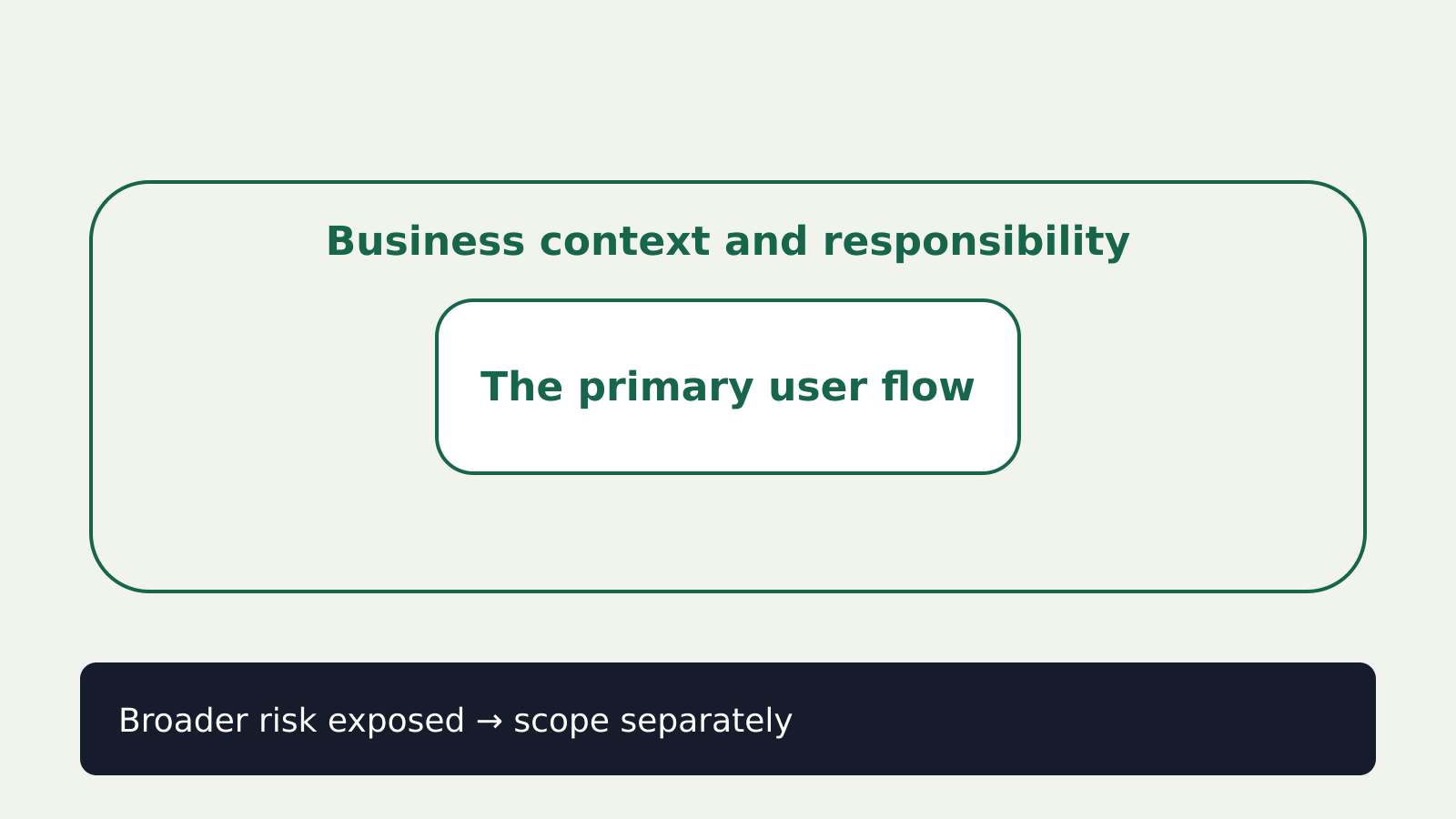
- Broader risk exposed → scope separately

Know what a focused audit can see
A short engagement can inspect the path, identify friction and rule gaps, compare plausible causes, and prioritize follow-up tests. It may reveal a broken handoff between sales and onboarding, a misleading confirmation message or a missing business rule. It cannot establish causal proof from a single walkthrough or certify the system’s security and legal compliance. Those need separate specialists and scope.
Define the output before buying
Ask for a concise map of the current journey, evidence for each finding, severity and confidence, recommended next decisions, and a meeting to resolve open questions. Separate observed defects from hypotheses. A useful recommendation says who should do what, why and how to check whether it worked. A long list of cosmetic changes without a decision order will not help a constrained founder.
Compare the next moves
- Fits: A working product with one bounded journey to investigate.
- Output: Independent findings and prioritized recommendations.
- Outside scope: Full-platform assurance, implementation and certification.

When to choose another route
If there is no working product, a discovery or blueprint engagement may be more appropriate. If the question is strictly usability of a particular interface, a UX review may be narrower. If the team needs someone to own the roadmap and execution over months, an audit alone will leave the responsibility unfilled. Confirm the current offer, inclusions and commercial terms directly before purchasing; the $1,500 figure in this title is the article’s illustrative offer framing, not a guarantee of suitability for every scope.
The next decision
Write the one product decision the audit must help resolve, then check whether the proposed scope can produce evidence for it.
Source note: GOV.UK Service Manual, understand service performance. The scenario and proposed allocation, where applicable, are illustrative; the linked source supports the underlying method or regulatory context.
Sources & scope
Related primary reading is provided below. The decision framework and fictional examples are Parikh Advisory’s analysis; these references do not establish that the illustrated events occurred.
- Understand users and their needsUK Government Digital Service